
Protection enchantment in Minecraft: a complete guide
The Protection enchantment reduces almost all incoming damage in Minecraft. Learn how the protection factor works, how to get it, and the…
Protection enchantment in Minecraft: a complete guide
The Protection enchantment is the basic armor enchantment in Minecraft, which evenly reduces almost all incoming damage regardless of its source. Unlike specialized enchantments, it works against mob attacks, as well as falling, fire, explosions, or even magic effects. Below is a breakdown of how Protection calculates damage reduction through the protection factor, where to get this specific enchantment, and which armor sets make sense in survival.
Relevant for Java Edition 26.2. The damage reduction mechanics haven't changed since 1.21, so the guide is suitable for this entire version branch.
What Protection does and what it saves you from
The enchantment reduces damage from almost any source. There are only four exceptions: starvation, the sonic boom of a warden, the void (falling out of the world), and the /kill command. Everything else — melee attacks, arrows, explosions, fire, falling from a height, damage from negative effects — Protection partially absorbs. It works even against sources that regular armor completely ignores, such as falling or poison.
The maximum level is IV. The enchantment can be applied to all armor pieces: helmet, chestplate, leggings, and boots, as well as the turtle shell in the helmet slot.
How much damage one item absorbs
Each piece of armor with Protection provides a reduction equal to the level × 4%. So one item with Protection IV mitigates 16% of the damage, and a full set of four such pieces mitigates 64%.
Level | One item | Full set (×4) |
I | 4% | 16% |
II | 8% | 32% |
III | 12% | 48% |
IV | 16% | 64% |
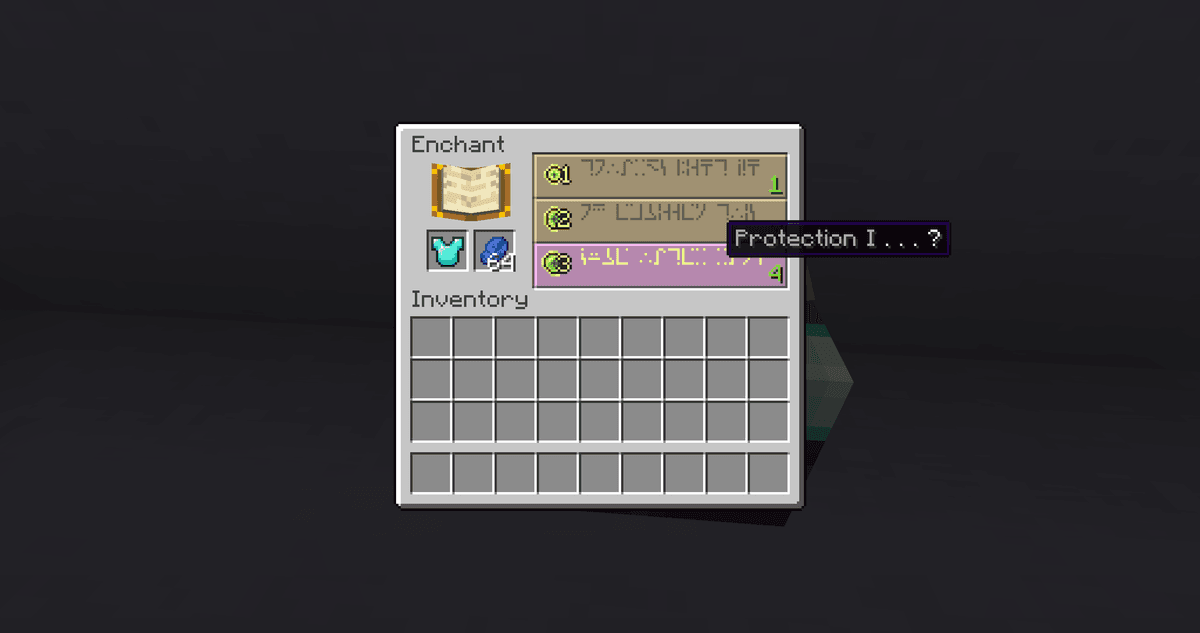
An enchanting table with a diamond chestplate placed inside; on the right, among the three options, Protection I is visible.
Protection factor and damage reduction formula
The game does not calculate the reduction in percentages directly, but through the Enchantment Protection Factor (EPF). Each level of the enchantment adds a certain number of EPF points, and these points are summed up from all worn armor pieces.
Protection — 1 EPF point per level.
Fire Protection, Blast Protection, Projectile Protection — 2 points per level.
Feather Falling — 3 points per level.
The sum of EPF from all pieces is capped at 20. Then each point reduces damage by 4%, so the reduction ceiling is 80% (20 × 4%). There is no random variance in modern versions: with the same set of enchantments, the result is always the same.
EPF ceiling = 20. Anything exceeding 20 points against a specific type of damage is discarded in the calculation. A full set of Fire Protection IV gives 32 points against fire, but only 20 actually work — the rest is lost.
Why Protection IV gives a maximum of 64%
One item with Protection IV is 4 EPF points, and a full set is 16. This is less than the ceiling of 20, so it is impossible to reach 80% with just Protection alone. Protection V does not exist in survival: the fifth level only appears through commands.
Enchantment | EPF per level | One IV item | Damage type |
Protection | 1 | 16% | almost all |
Fire Protection | 2 | 32% | fire |
Blast Protection | 2 | 32% | explosions |
Projectile Protection | 2 | 32% | projectiles |
Feather Falling | 3 | 48% | falling |
Armor is calculated first, enchantments second
First, armor points reduce the damage, and only the remainder is processed by enchantments. For example, a full diamond set mitigates 80% of a strike, and 20% passes through the armor. If the enchantments provide an additional 40% reduction, they remove 40% of that 20%, which adds 8% — making a total of 88%. For damage types that armor points do not protect against (primarily falling), the enchantment remains the sole source of reduction, and here the 80% ceiling is calculated from the full damage.
Specialized protection enchantments
The three specialized enchantments provide twice as much EPF per level as Protection, but only against their specific type of damage. They are more effective against a particular threat, but do not work outside of it.
Fire Protection
Reduces damage from fire, lava, magma blocks, lit campfires, and mobs that deal fire damage (blaze fireballs, flaming arrows, burning zombies). One item with Fire Protection IV mitigates 32% of such damage. An additional effect is the reduction of burn time by approximately 15% per level; the effect stacks across pieces, and a total of 7 levels makes the character practically non-flammable. Damage from direct contact with a blaze or magma cube counts as a melee attack, and is not reduced by this enchantment.

A player falls into lava wearing a fully enchanted armor set with fire protection
Blast Protection
Mitigates damage from any explosions: creepers, TNT, ghast fireball explosions, as well as exploding beds or respawn anchors not in their proper dimension. One IV item absorbs 32% of explosion damage. A side effect is the reduction of explosion knockback by 15% per level, up to a maximum of 60%. This effect does not stack: only the highest level among the worn pieces is taken into account.
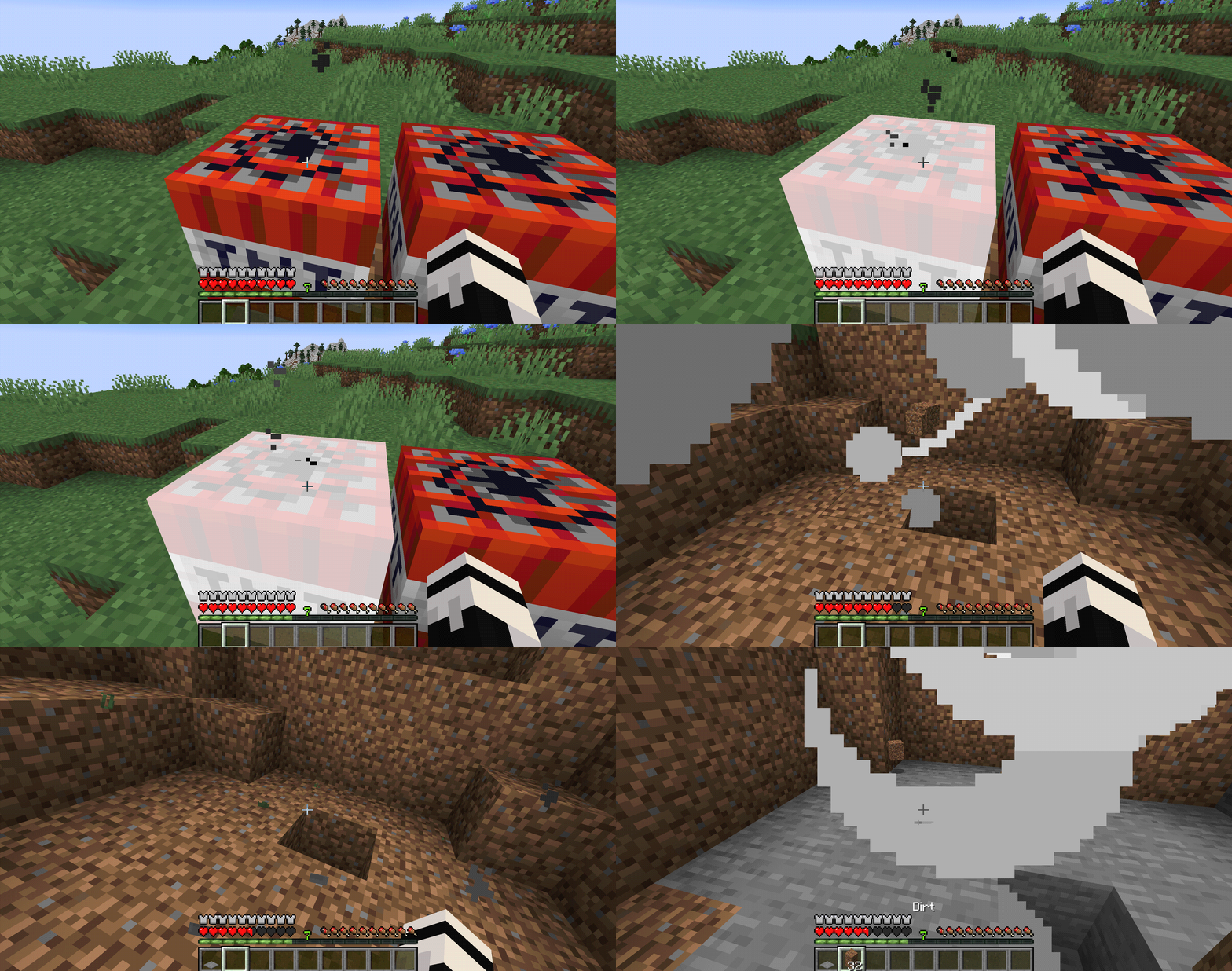
A player is blown up by TNT and takes less damage thanks to the enchantment
Projectile Protection
Works against arrows, thrown tridents, shulker bullets, llama spit, and blaze fireballs, as well as direct hits from ghast fireballs and wither skulls (but not against their explosions). One IV item gives a 32% reduction. This enchantment does not work against splash potions of harming, fireworks, or sonic booms: such damage is not considered projectile.
Feather Falling — an exception to the rules
Applied only to boots and reduces fall damage: 12% per level, meaning Feather Falling IV is 48%. Unlike the three specialized ones, it does not conflict with them, so boots can easily accommodate, for example, both Protection IV and Feather Falling IV simultaneously.
Incompatibility. Protection, Fire Protection, Blast Protection, and Projectile Protection cannot be combined on the same item. Trying to do so on an anvil will erase the enchantment from the first slot and replace it with the one in the second. Feather Falling does not fall under this rule.
How to get Protection
Enchanting table
The easiest path. You place the armor in the table, add 1–3 lapis lazuli — and Protection often drops among the three options because it is a common enchantment with a low cost. To see options up to level 30, the table should be surrounded by bookshelves (up to 15 blocks at a distance of one block).
Enchanted books
Protection can be found as a book while fishing, in dungeon chests and various structures, as well as by trading with a librarian villager for emeralds. The book is then applied to the armor via an anvil.
Anvil: combining and upgrading levels
On an anvil, a book or an enchanted item transfers the enchantments to the armor. Two identical items with Protection III will yield Protection IV; two items with Protection IV will not create a higher level, as IV is the ceiling. Each combination increases the "work cost" of the item in experience, so the merging order should be planned in advance.
Combining two specialized protections on one item is impossible — the anvil will keep only one. Different types should be distributed across different armor pieces rather than collected on one.
Practical armor sets
Universal set
Protection IV on all four pieces — a 64% reduction from almost everything. This is the foundation for survival that doesn't require swapping armor for every situation. Feather Falling IV is additionally put on the boots, and for durability — Unbreaking III and Mending.
Against creepers and explosions
One piece (usually the chestplate or boots) is swapped for Blast Protection IV. Three pieces of Protection IV give 12 EPF points against regular damage, and together with the 8 points from the specialized protection, it results in exactly 20 against explosions — the 80% ceiling. This significantly saves you from a close creeper detonation.
For the Nether and fire biomes
One piece with Fire Protection IV raises fire resistance to 80% when paired with the rest of the Protection and almost eliminates burn time. The other slots are left for Protection for the sake of versatility.
Against skeletons and pillagers
Against heavy fire, one piece is dedicated to Projectile Protection IV. Outside of shootouts, its effect is zero, so it's more convenient to keep such armor as a separate set.
Set | Armor setup | Against what | Resistance |
Universal | 4× Protection IV | almost everything | 64% |
Anti-blast | 3× Protection IV + 1× Blast Protection IV | explosions | 80% vs explosions, 48% rest |
Fire | 3× Protection IV + 1× Fire Protection IV | fire | 80% vs fire, 48% rest |
Anti-projectile | 3× Protection IV + 1× Projectile Protection IV | arrows | 80% vs projectiles, 48% rest |
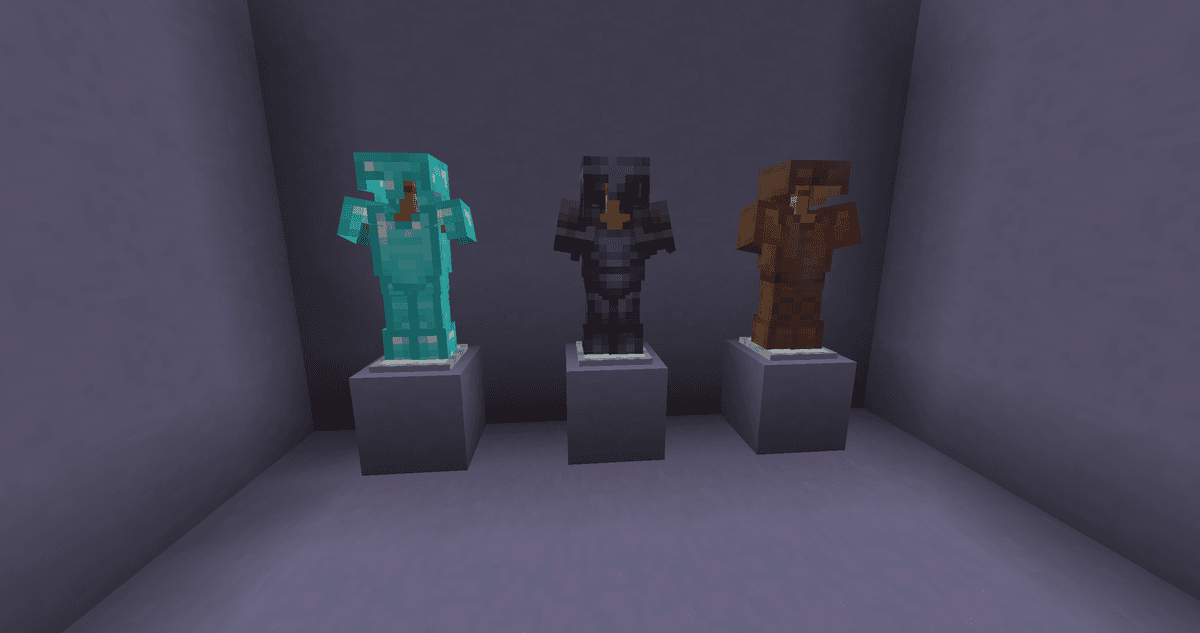
Three sets of fully enchanted armor
Common mistakes and how to avoid them
Putting two specialized protections on one piece. The anvil will erase one of them. Different types need to be scattered across different items.
Waiting for Protection V from the table. It doesn't exist in survival — the ceiling is level IV. The fifth level is only accessible via commands.
Wearing a full set of Fire Protection. One specialized piece together with three Protection IV pieces is already enough for 20 EPF points against fire (80%); the rest of the pieces dedicated to Fire Protection just take away universal resistance.
Confusing armor protection and enchantment protection. Armor points don't work against falling — only Protection and Feather Falling will save you. Without these enchantments, falling damages you completely.
Relying on a "lucky" roll. In older versions, damage reduction had a random variance; now the result is fixed, so the "lucky or not" principle no longer applies.
Applying Feather Falling to all pieces. It only goes on boots; it won't be on the helmet, chestplate, or leggings.
Conclusion
Protection absorbs almost any incoming damage equally, from a zombie strike to falling down a mineshaft. For regular survival, a full set of Protection IV remains the optimal choice, as it doesn't force you to keep separate armor for every situation.
The limitation is also specific: you cannot go above 64% with just Protection, and against fire, explosions, or projectiles, specialized enchantments are twice as effective per level. Therefore, for a specific threat, it is worth replacing one or two armor pieces with a specialized variant, consciously sacrificing a bit of universal resistance.
Compared to specialized enchantments, Protection loses in peak resistance against a single damage type, but wins in the fact that it always works without exception. Specialized enchantments, on the other hand, only make sense narrowly: the Nether, PvP with bows, or a base under the threat of creepers.
For pure survival and hardcore, the logic is simple: the foundation is Protection IV on all gear, boots with Feather Falling, and if necessary, one specialized slot for the main threat of a specific expedition.
Leave a comment
Links will be stripped
No comments yet. Be the first to share your thoughts.