
Riptide, Loyalty, and Channeling — Minecraft Trident Enchantments Guide
A complete guide to Trident enchantments in Minecraft: Riptide, Loyalty, and Channeling. Learn how they work, their levels, compatibility…
Riptide, Loyalty, and Channeling — Minecraft Trident Enchantments Guide
The Trident in Minecraft has four unique enchantments, and three of them completely change how this weapon works: Riptide turns the trident into a means of transportation, Loyalty returns it to your hand after throwing, and Channeling summons lightning to the target. This guide covers all three enchantments: their working conditions, levels, compatibility with each other, and common mistakes that prevent their mechanics from working.
None of these enchantments can be applied to any other item — they are exclusively tied to the trident. Therefore, it is worth figuring out first where to get the weapon itself and how to enchant it, and only then move on to each effect individually.
The mechanics are described for Java Edition. In Bedrock Edition, some conditions differ — key differences are marked separately in the text.
Where to get a Trident
The trident cannot be crafted. You can only get it in two ways: drop it from a Drowned or find it in the chests of a Trial Chamber.
In Java Edition, only 6.25% (1 in 16) of naturally spawned Drowned hold a trident. When a player kills such a mob, the base chance of the weapon dropping is 8.5%. Each level of the Looting enchantment on the weapon used for the killing blow adds +1% to this chance, up to a maximum of 11.5% with Looting III. Because of these numbers, the fastest farming is in ocean biomes and rivers, especially at night, where Drowned spawn en masse.
Converted zombies do not have tridents. A normal zombie that drowned and became a Drowned never receives this weapon. You should only hunt those that spawned in the water already as a Drowned.
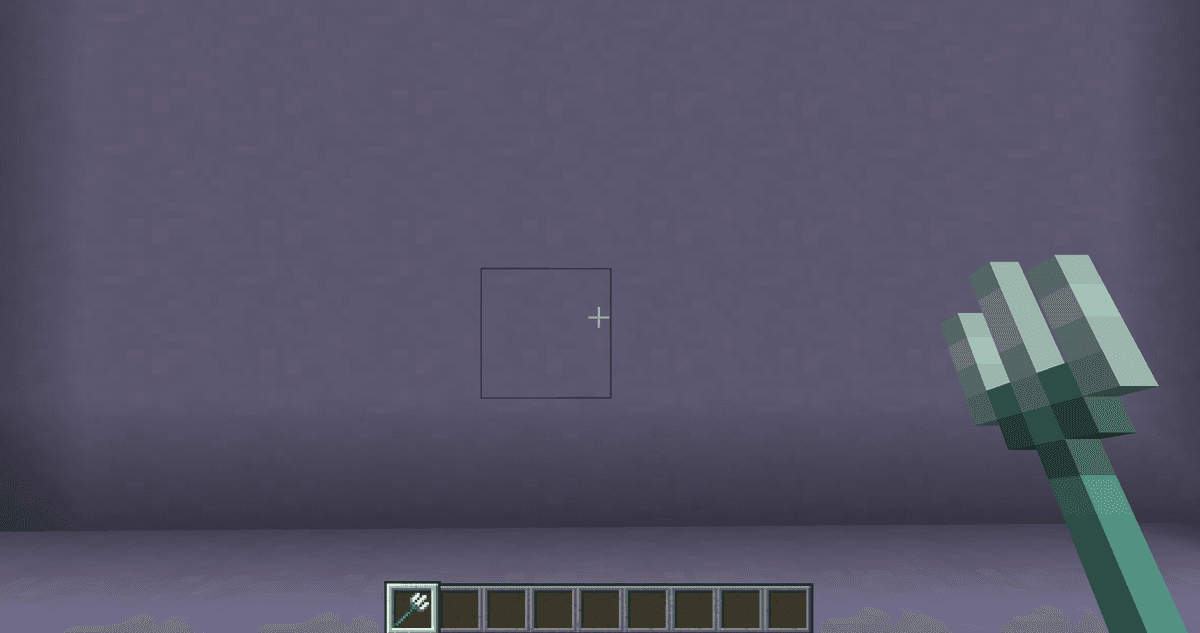
A trident in the player's hand
How to apply enchantments
A trident can be enchanted in two ways: through an enchanting table or via an anvil with an enchanted book. Both options yield the same result, the only difference being how random the set of enchantments you get will be.
Enchanting Table
The trident is among the items that the enchanting table accepts directly. Place it in the slot, add lapis lazuli — and the game will offer three options. To get strong enchantments (specifically Riptide and Channeling), you need access to level 30 enchanting: 15 bookshelves placed around the table with a one-block gap.
The set offered by the table is random, so a specific enchantment might not drop on the first try. If no option suits you, enchant any cheap item — this will change the hidden "seed" and refresh the list.
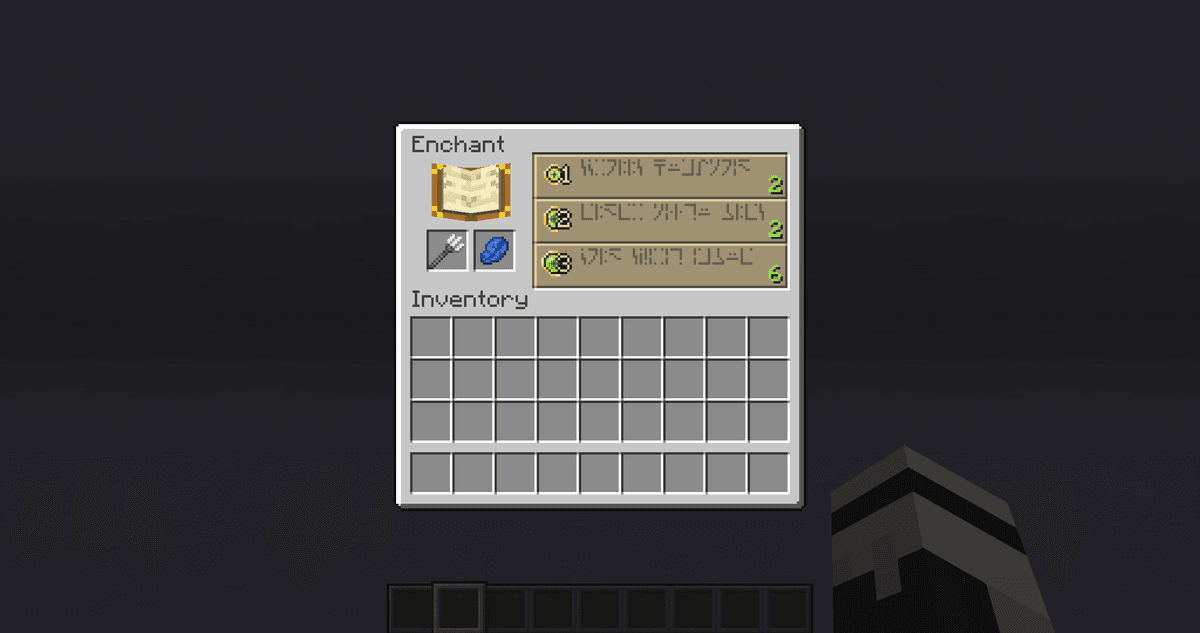
Enchanting table interface with a placed trident
Anvil and Enchanted Books
The second way is more precise: find an enchanted book with the desired effect and transfer the enchantment to the trident using an anvil. Enchantments can be obtained by fishing, trading with a librarian, or from chests in structures — desert temples, mineshafts, strongholds, ocean ruins, woodland mansions, pillager outposts, ancient cities, and trial chamber vaults.
The rarity of enchantments varies. The table below shows the enchantment weight: the lower the number, the rarer it drops.
Enchantment | Max. level | Weight (rarity) |
Loyalty | III | 5 (common) |
Riptide | III | 2 (rare) |
Channeling | I | 1 (rarest) |
Repairing the Trident
A trident endures as many hits as an iron sword, and each throw or strike consumes one durability point. It can be repaired by combining two tridents in an anvil — the enchantments of both are preserved, and the durability receives an additional +5%. Alternatives include the Mending enchantment, which restores the weapon using gained experience, and Unbreaking, which slows down wear and tear. Both are compatible with all three main effects.
Loyalty — returning the trident
Loyalty forces a thrown trident to return to its owner after hitting a block or entity. Without this enchantment, the thrown weapon simply gets stuck where it landed, and you have to pick it up manually — and a rare trident is easy to lose in combat or over water.
The return begins immediately after hitting a mob or 5 ticks (0.25 seconds) after hitting a block. On its way back, the trident passes through all blocks and entities in a straight line, so obstacles don't stop it.
Speed by levels
The level of the enchantment only affects how quickly the weapon flies back. It does not affect damage.
Level | Return speed |
Loyalty I | ≈16.7 blocks/s (slow) |
Loyalty II | ≈33.3 blocks/s (twice as fast) |
Loyalty III | 50 blocks/s (almost instant) |
At the third level, the pause between throwing and returning is so short that you can throw the trident almost continuously, like a ranged melee weapon.
When the trident doesn't return
There are a few situations where Loyalty won't save your weapon:
The Void. In Java Edition, a trident thrown into the void is destroyed — there's nothing to return from, as there are no blocks or entities there. (In Bedrock Edition, it returns after flying about 15 blocks.)
Owner's death. If the player dies or enters Spectator mode while the weapon is flying back, the trident drops as an item and may despawn over time.
Full inventory. When there is no free slot, the trident circles the player until a space frees up. This allows you to "queue up" several tridents at once.
The weapon returns through lava without issue — it catches fire but flies right into your hand, which is handy in the Nether. The trident also isn't lost between dimensions: it stays where it was thrown and continues its return as soon as the player goes back there.
The main risk is the End void. Throwing a trident over the abyss in Java Edition means losing the weapon forever, along with all enchantments. In the End dimension, only throw it where there is land underneath.
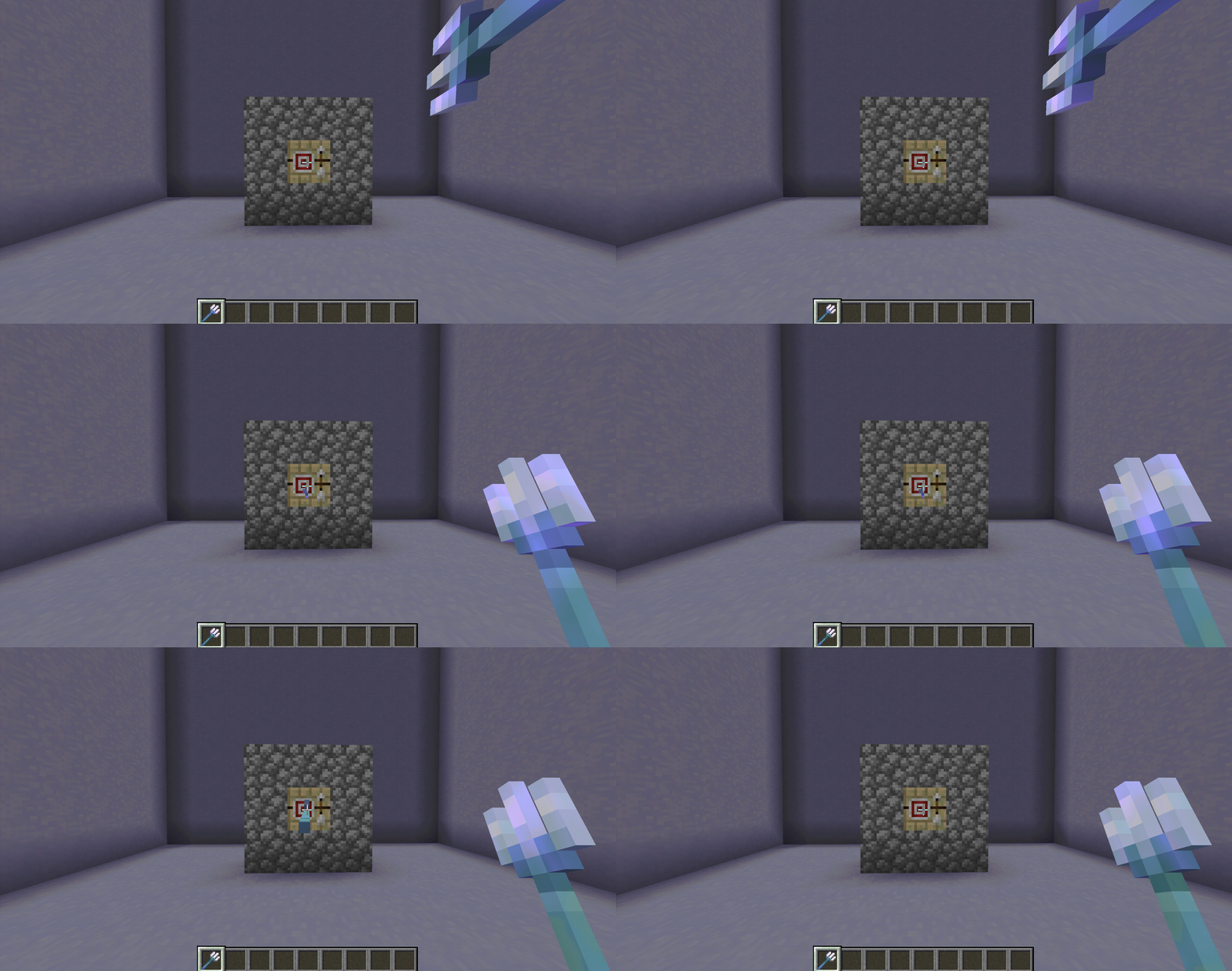
The player throws the trident at a stone wall opposite them; the weapon sticks and a moment later flies straight back into their hand
Riptide — dashing through water and rain
Riptide doesn't throw the trident like a projectile, but launches the player themselves in the direction they are aiming. The weapon stays in hand. This effect only works under one condition: the player must be wet — standing in water or in the rain.
To dash, hold down the use item button (like drawing a bow) and release when fully charged. The player rockets off in the direction the camera is facing. Throwing it vertically upwards results in a high jump; throwing it downwards from a height or while running results in a long forward dash.
Distance by levels
The dash distance depends on the level. On the surface (in water or rain), it is calculated by the formula (6 × level) + 3 blocks:
Level | Distance on surface | Underwater |
Riptide I | 9 blocks | 7 blocks |
Riptide II | 15 blocks | 11 blocks |
Riptide III | 21 blocks | 15 blocks |
Each use takes 1 durability point, and if the player crashes into a mob mid-flight, it takes an extra point. Hitting a target deals the usual throwing damage, and if you fall on an enemy from above after a dash, the strike counts as a critical hit.
Flying with Elytra
The most powerful application of Riptide is propelling elytra. In the rain or over water, the dash gives elytra such an impulse that the speed surpasses flying with fireworks several times over. This is the only vanilla way to "fly" without spending rockets, but it is tied to the weather and bodies of water.
In dry biomes, the effect is dead. Riptide won't work where rain physically doesn't fall — in deserts, savannas, the Nether, or the End. Snow or cloudiness without precipitation also don't count: you specifically need rain or to be submerged in water.

The player stands waist-deep in water, charges the trident while looking up, and upon release flies out of the water high into the air
Channeling — summoning lightning
Channeling turns the trident into a source of controlled lightning strikes. When the thrown weapon hits a mob, player, entity, or lightning rod, a lightning bolt strikes the target — but only under strict conditions.
In Java Edition, two things must happen at once: there must be a thunderstorm outside (not just rain), and the target must be under the open sky. If there is even a partially opaque block, a roof, or a cave ceiling above the mob, the lightning will not strike, even if the trident hits perfectly. In Bedrock Edition, the conditions are milder: striking a lightning rod works during any rain, without a thunderstorm.
The maximum enchantment level is only I; higher levels do not exist. You can summon a thunderstorm for testing using the /weather thunder command.
Transforming mobs
The lightning from Channeling acts just like natural lightning, so it is convenient for triggering rare transformations:
Creeper → Charged Creeper — the explosion becomes much more powerful, and such a creeper drops the heads of other mobs.
Villager → Witch.
Pig → Zombified Piglin.
Mooshroom changes to its opposite color (red ↔ brown).
Lightning won't strike a mob in a "protected" state. If the target is standing in water, lava, powder snow, a cobweb, on soul sand, a honey block, or mud, the strike won't go through. Choose a dry, open area.
Channeling advancements
This enchantment unlocks two advancements. Surge Protector — protect a villager from an undesired shock by lighting a lightning rod near them. Very Very Frightening — strike a villager with lightning (they will turn into a witch).
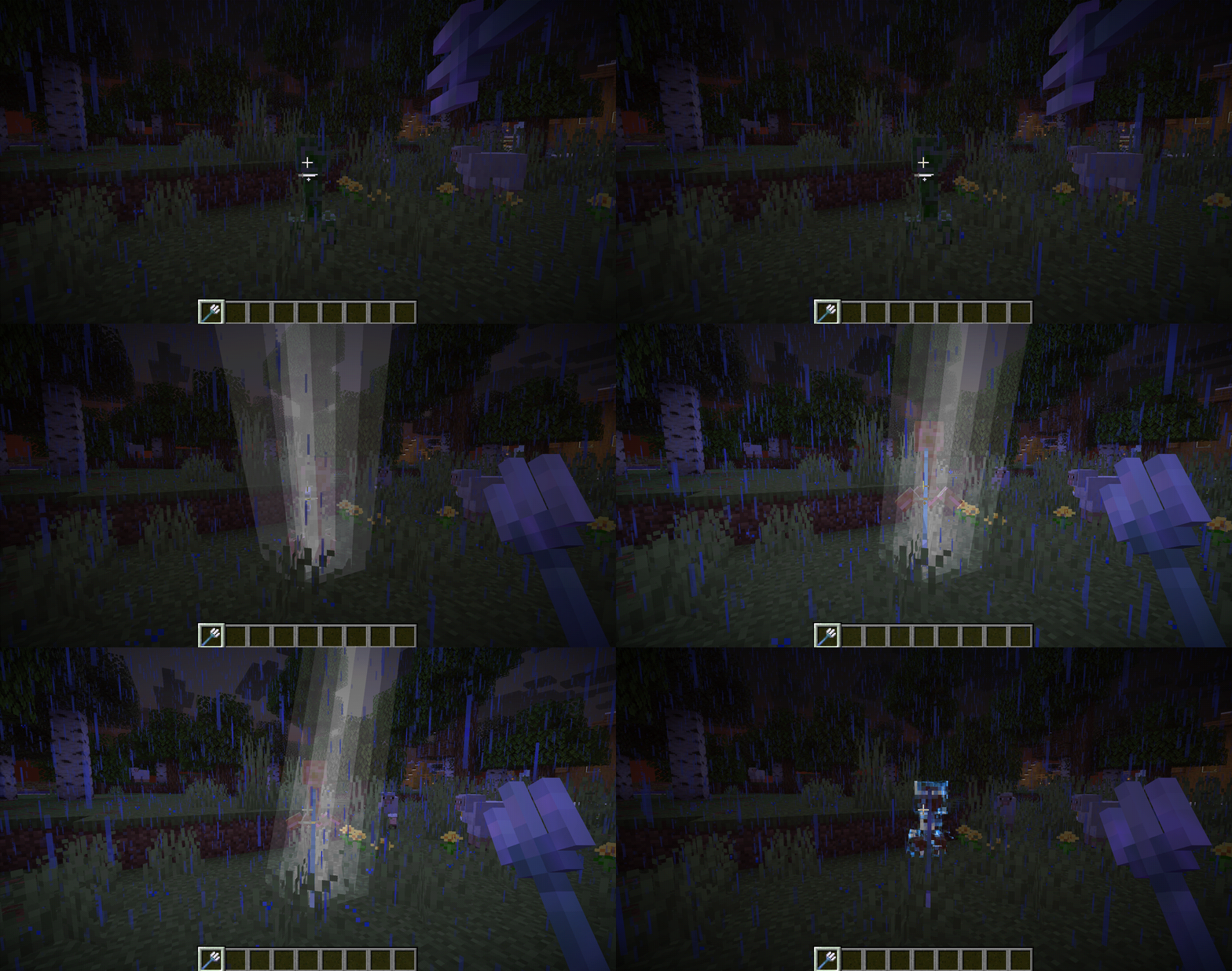
During a thunderstorm, the player throws a trident at a creeper; upon hitting the mob, a bright lightning bolt strikes, and the creeper lights up with the blue aura of a charged state
Enchantment compatibility
The three effects cannot be combined arbitrarily. The key limitation revolves around Riptide.
Combination | Compatibility |
Loyalty + Channeling | Yes — work together |
Riptide + Loyalty | No — conflict |
Riptide + Channeling | No — conflict |
The logic is simple: Riptide prevents the trident from leaving your hand, so there's nothing to return or strike with lightning at the impact point. Therefore, in practice, players assemble two different tridents:
Combat: Loyalty III + Channeling I, plus optionally Impaling for damage against aquatic mobs, Unbreaking, and Mending. Such a trident returns to hand and strikes with lightning during a thunderstorm.
Travel: Riptide III as a separate weapon — only for moving through water, rain, and propelling elytra.
Common mistakes and how to avoid them
Throwing a "loyal" trident into the void. In Java Edition, the weapon disappears forever. Do not throw the trident at all over the End abyss — only fight with it at close range.
Expecting a Riptide dash without water or rain. In the desert, savanna, or Nether, the effect will not activate. The player needs to be wet — otherwise, the throw simply doesn't happen.
Confusing rain and thunderstorm for Channeling. In Java Edition, normal rain does not summon lightning — you need specifically a thunderstorm with thunder. If the sky is bright and there is no lightning on the horizon, the enchantment will remain silent.
Target under a roof with Channeling. A mob in a cave, under an awning, or a tree is protected from the strike. Lure them out into an open area under the sky.
Trying to combine Riptide with Loyalty or Channeling. The enchanting table will not offer such a pair, and through an anvil, only Riptide will remain active. Keep these roles on different tridents.
Full inventory at the moment of return. A "loyal" trident will circle the player until a slot is freed up — leave space before actively throwing.
Conclusion
Riptide, Loyalty, and Channeling cover three different tasks, and are almost never needed on a single trident. Loyalty is a basic comfort: it makes a thrown trident reusable and saves a rare weapon from being lost, making it suitable for anyone who throws a trident at all. Channeling is a niche combat and farming option: strong against enemies in a thunderstorm and irreplaceable for charged creepers and mob transformations, but dependent on the weather and an open sky. Riptide stands apart — it is not a weapon, but transport: fast movement through water, rain, and propelling elytra, at the cost of total incompatibility with the other two effects.
Compared to a bow or crossbow, a trident with these enchantments provides things that ranged weapons cannot: the return of the projectile to the hand, controlled lightning, and personal mobility. The main limitations are the rarity of the trident itself and the weather dependency of two of the three enchantments. For survival and PvP, build a combat trident with Loyalty and Channeling, and keep a separate Riptide for exploring the Minecraft world — and don't try to cram all three effects into one weapon.
Leave a comment
Links will be stripped
No comments yet. Be the first to share your thoughts.