
Sweeping Edge — a sword enchantment for sweeping attacks in Minecraft
Sweeping Edge is a Minecraft sword enchantment that boosts sweeping attack damage against nearby mobs. Learn how it works, how to get it…
Sweeping Edge — a sword enchantment for sweeping attacks in Minecraft
Sweeping Edge is a sword enchantment in Minecraft that increases the damage of sweeping attacks against nearby mobs. The sword hits one primary target, but with a fully charged attack, it also hits those standing nearby. Without this enchantment, such a sweep deals only a symbolic amount of damage to nearby enemies; Sweeping Edge raises it to a substantial level and turns the sword into a tool for quickly clearing out crowds of mobs.
The sweeping attack and the Sweeping Edge enchantment work exclusively in Minecraft Java Edition. Bedrock Edition does not have this attack mechanic, so the enchantment is also absent there.
What Sweeping Edge does
The enchantment only affects the sweeping attack — a specific type of sword strike that deals area-of-effect damage. The main target takes normal damage, and all mobs around it take additional damage. Sweeping Edge increases only this additional damage to the surroundings and does not change the strike against the main target.
The sweep is available to the sword by default: an unenchanted sword also hits neighbors, but it deals only 1 point of damage to them. The role of the enchantment is to scale this value. The bonus depends on the level: 50% of the sword's damage at level I, about 67% at level II, and 75% at level III. The maximum level is III.
What is a sweeping attack
The sweep works only under three conditions simultaneously: the character is standing on the ground, not sprinting, and the attack cooldown meter is filled to at least 84.8%. The moment of the sweep can be seen by the characteristic arc of particles from the sword. If you hit immediately after a previous strike, before the meter has regenerated, a regular single strike will occur instead of a sweep. The sweeping attack also cannot be combined with a critical hit: a critical requires jumping and falling, while a sweep requires standing on the ground. The exception regarding movement is that the sweep still works during diagonal sprinting, but it's more reliable to just stand still or walk slowly.
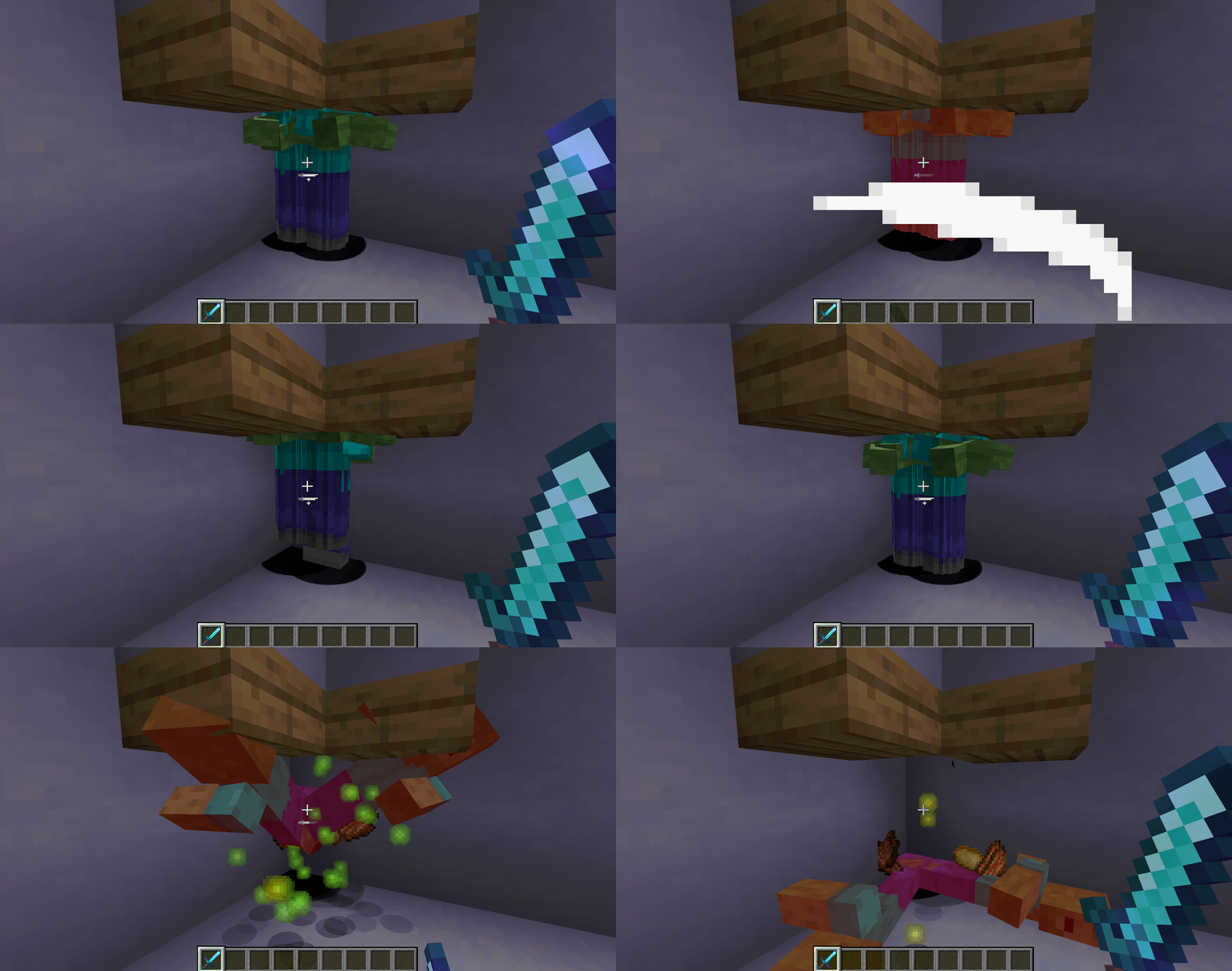
Sweeping sword attack against a group of zombies
Area of effect and knockback
The sweep hits enemies in a 1 × 0.25 × 1 block area around the main target, provided their feet are no further than 3 blocks from the player's feet. Every affected mob takes damage and gets knocked back. The knockback strength from the sweep is 80% of the base and does not depend on the Knockback enchantment — even with it, it remains the same.
The area is small, so the enchantment only shines when enemies are standing close to each other. If mobs are scattered, the sweep will hit only one or two neighbors, and there will be almost no benefit from the enchantment. Knockback works against you here: after the first sweep, the group is knocked back and scatters, so it's desirable to land subsequent strikes while the enemies are still grouped together.
How much damage the enchantment adds
Sweeping Edge does not add a fixed number, but calculates a fraction of the sword's damage. Therefore, one level provides a bigger boost on a netherite sword than on a wooden one.
Formula
Damage to each affected mob:
1 + sword_damage × (level / (level + 1))
The result is rounded to the nearest integer. "Sword_damage" here is the final weapon damage after accounting for Sharpness, Smite, or Bane of Arthropods, so these enchantments increase both the base strike and the sweep damage simultaneously.
Fraction by level:
Level I: 1/2 = 50%
Level II: 2/3 ≈ 67%
Level III: 3/4 = 75%
The bonus cap is 100% of the sword's damage; it is only achieved at level 199, which is only accessible through commands.
Base sword damage
To calculate the result for your weapon, plug the base sword damage into the formula:
Wooden / Golden: 4
Stone: 5
Iron: 6
Diamond: 7
Netherite: 8
Calculation examples
An iron sword (damage 6) with only Sweeping Edge I deals each neighboring mob 1 + 6 × (1/2) = 4 points of damage (2 hearts).
A netherite sword (damage 8) with Sweeping Edge III deals 1 + 8 × (3/4) = 7 points (3.5 hearts) to each affected mob.
A diamond sword (damage 7) with Sharpness V, which raises the final damage to 10, in combination with Sweeping Edge III gives 1 + 10 × (3/4) = 8.5 points (4.25 hearts). For comparison, a sword without this enchantment deals nearby enemies only 1 point (half a heart) — the full level increases the area damage several times.
How to get Sweeping Edge
Enchanting table
The sword is enchanted directly at the table, spending experience and lapis lazuli. Sweeping Edge is a primary enchantment for the sword, so it appears in the list of options. Its weight is 2 — a low value, so it appears in the list less often than common enchantments like Sharpness. If the desired option is not there, the list can be refreshed: enchant a book or another item for 1 level and 1 lapis lazuli — the set of options for the sword will change.
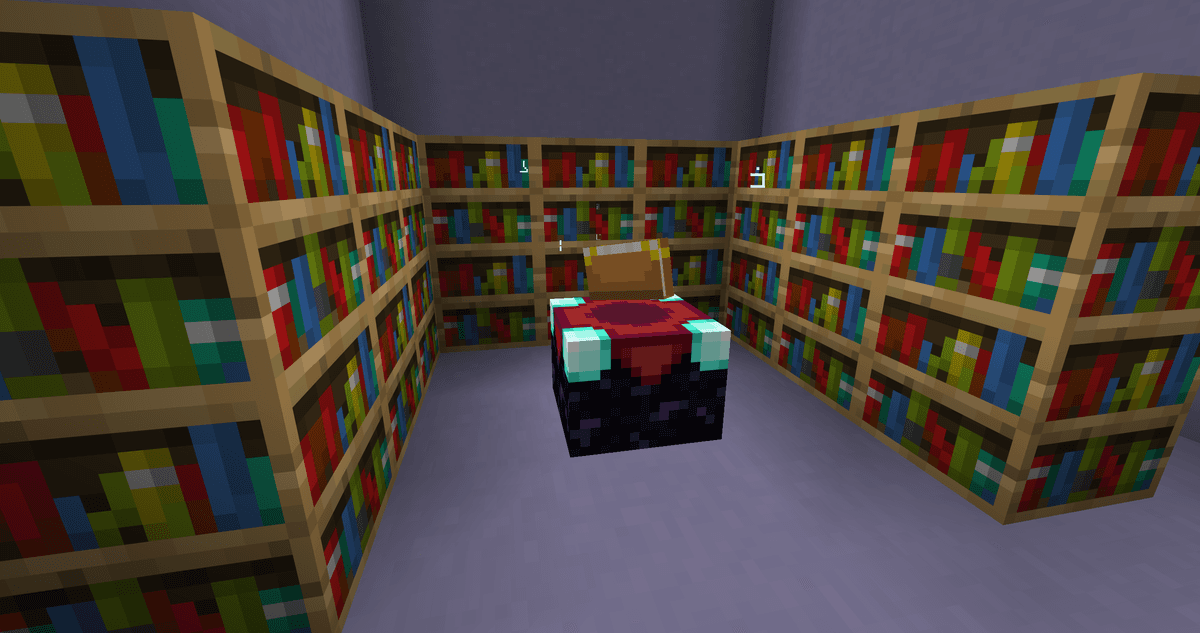
An enchanting table surrounded by bookshelves
Enchanted books
The second way is to find a "Sweeping Edge" book and apply it to the sword via an anvil. Books can be found while fishing, in chests of monster rooms with a spawner, in chests of underwater ruins, and in the loot of non-village structures where enchanted books generate. Separately, librarian villagers sell them: you can buy a ready-made book of the desired level for emeralds, without relying on the randomness of the table. This is the most stable way to purposely get specifically Sweeping Edge III.
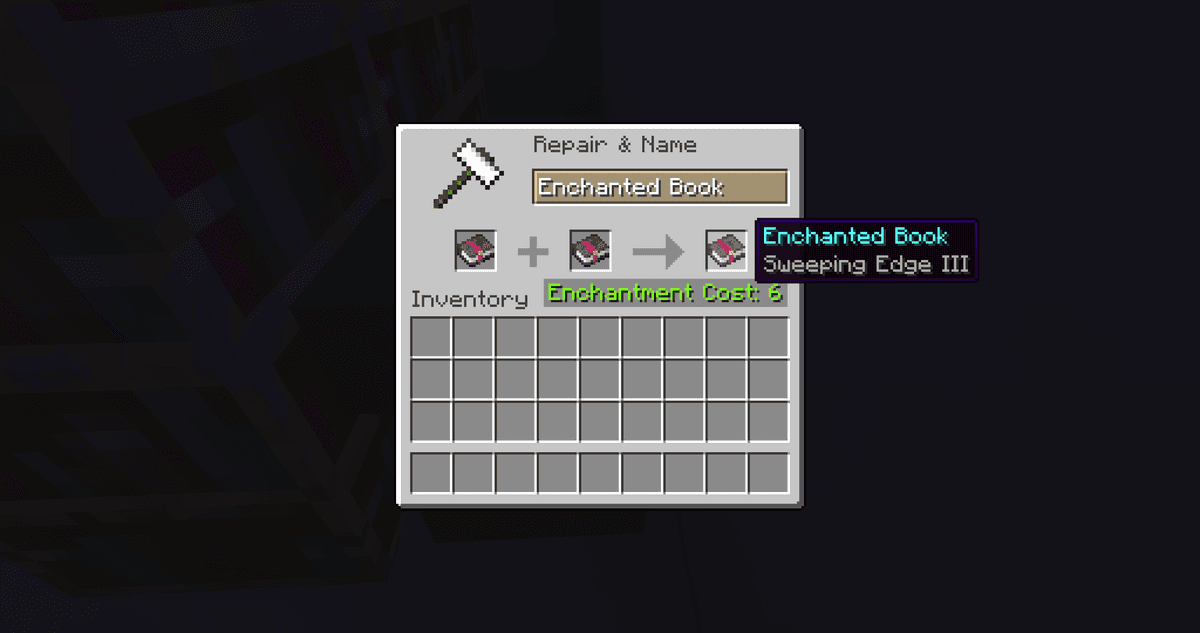
Combining two Sweeping Edge II books to get Sweeping Edge III
Anvil and command
To transfer an enchantment from a book to a sword, both items are placed in an anvil; it also shows the cost in experience levels. Two identical books of a lower level combine into a book of a higher level — so two "Sweeping Edge II" make a "Sweeping Edge III". If commands are enabled in the world, enchantments are issued directly:
/enchant @s sweeping_edge 3
The command works for a player with appropriate permissions and applies level III to the item in hand.
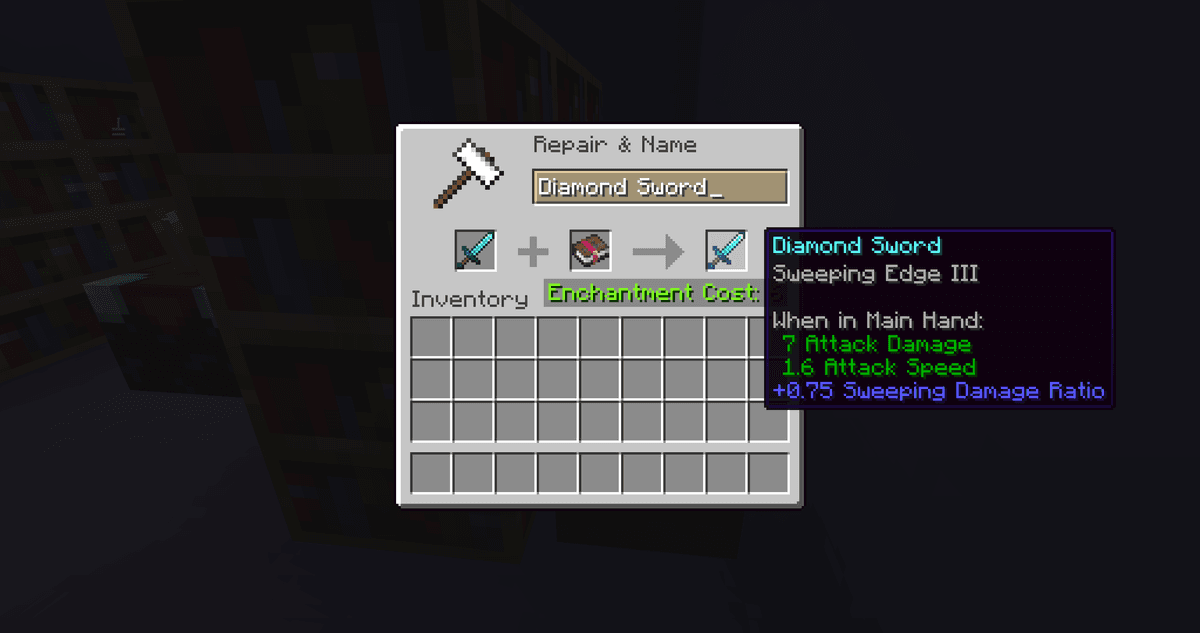
Anvil interface — a diamond sword in the left slot, a "Sweeping Edge III" book in the center
Compatibility with other enchantments
Sweeping Edge combines with all other sword enchantments and, unlike damage-boosting enchantments, does not conflict with anything. Sharpness, Smite, and Bane of Arthropods are mutually exclusive, but Sweeping Edge goes on a sword alongside any of them. Since the sweep damage is calculated from the final damage of the sword, the Sharpness + Sweeping Edge combination boosts itself: Sharpness increases the number from which the percentage is taken, and Sweeping Edge increases the percentage itself.
How to build a sword with Sweeping Edge III
The steps for a complete combat build:
Take a good sword — diamond or netherite, so the base damage is higher.
Get a "Sweeping Edge III" book: buy it from a librarian, find it in a structure, or combine two "Sweeping Edge II" in an anvil.
Apply the book to the sword via an anvil.
Add the rest of the enchantments with separate books — Sharpness V, Unbreaking III, Mending, optionally Looting III and Fire Aspect.
Order in the anvil: each combination increases the "prior work penalty", and eventually the anvil says "Too Expensive". To avoid this, first combine the books with each other into larger books, and only then apply them to the sword, rather than adding them one by one.
Where to use
Sweeping Edge truly shines where enemies stand tightly. In mob farms, where zombies or skeletons pour onto a narrow platform in a crowd, one sweep takes out the whole line at once. The same applies to raids: enemies approach in groups, and the area damage clears them faster than a series of single strikes. In caves, the enchantment helps when several mobs come at the player together — it's enough to turn around and clear the group in one motion while the cooldown meter is full.
The most noticeable boost is seen in farms where mobs pack themselves into a dense column in front of the killing spot — for example, a zombie or spider farm with a water stream driving them into one point. There, every sweep hits several targets at once, and Sweeping Edge III noticeably reduces the number of hits per wave.
In one-on-one fights it is weaker. Sweeping Edge does not add damage to the primary target, so against a tough mob or boss, Sharpness or Smite are more useful.
Common mistakes
Striking while sprinting. The most frequent reason why the sweep "doesn't work": attacking while running. The sweeping attack requires the character to stand still or walk slowly; sprinting results in a regular single-target hit.
Spamming attacks. If you click the sword without pauses, the cooldown meter does not have time to fill up to 84.8%, and the sweep does not activate. You need to maintain a rhythm and strike as the meter recovers.
Expecting damage on the main target. Sweeping Edge does not boost the strike on the one hit directly. If the goal is to kill one tough mob faster, the effect will not help; it works only on the surroundings.
Trying to find it in Bedrock Edition. Bedrock has neither the attack cooldown nor the sweeping attack as it exists in Java, so Sweeping Edge is absent there.
Relying only on the enchanting table. Due to the low weight, the enchantment rarely drops at the table. It is more reliable to get the book from a librarian or from structures.
Critical hit instead of a sweep. If you jump and strike while falling, a critical hit triggers, not a sweep. These two types of attacks are incompatible, so for area damage, you must strike from the ground.
Conclusion
Sweeping Edge increases sword damage against clusters of mobs. In farms, raids, and caves, it saves time by allowing you to take down several enemies in one sweep instead of a series of individual strikes. The main limitation is that the enchantment does not affect damage to the main target, so in duels and against bosses, it falls short of Sharpness, which hits a single point. The optimal choice is not to pick between them, but to apply both: Sharpness accounts for strike power, Sweeping Edge for coverage. Such a combination is suited for players who fight crowds a lot: owners of mob farms, raid participants, and anyone who frequently clears dark areas in Minecraft.
Leave a comment
Links will be stripped
No comments yet. Be the first to share your thoughts.