
Fortune in Minecraft: Complete Enchantment Guide
Everything you need to know about the Fortune enchantment in Minecraft: mechanics, probabilities, tool compatibility, and comparison with…
Surviving in Minecraft Java Edition constantly requires a large number of resources — from coal and iron to diamonds and emeralds. Regular ore mining yields a fixed amount of items, making progression quite slow. Applying the Fortune enchantment to your tools allows you to increase the material yield from a single block without changing the overall reserves of ore veins. This guide details the mechanics of the enchantment, its mathematical foundations, compatibility with various blocks, and optimal usage strategies.
1. Description and primary purpose of the enchantment
The Fortune enchantment increases the number of items dropped when breaking certain blocks with tools. The maximum vanilla level of this enchantment is III.
Applicable tools
You can apply this enchantment to the following tools:
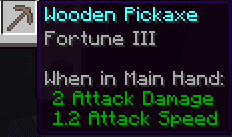
Pickaxe: The primary tool for mining valuable ores.
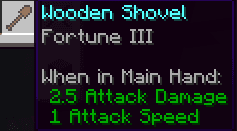
Shovel: Used for gathering gravel, clay, and mud.
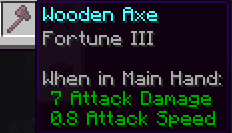
Axe: Increases the drop rates of apples and saplings from leaves, as well as additional items from some specific wooden structures.
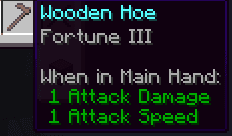
Hoe: Becomes the main tool for quickly harvesting crops on farms and clearing tree leaves.
2. Mathematical apparatus: probability calculation formula
The operation of the Fortune enchantment is based on random variables and discrete probability distribution. For most solid blocks (like diamond or coal ore), the game uses a fixed formula to determine the amount of item drops.
Mathematical formula
Let the enchantment level be LL (where LL takes values from 1 to 3). When breaking a block, the game generates a random number from 00 to L+1L+1 inclusive.
If the number 00 drops, the player receives the base amount of items (1 unit).
If any number greater than zero drops (let's denote it as kk, where 2≤k≤L+12≤k≤L+1), the drop amount is multiplied by the value kk.
The probability of a base drop occurring (without increase) is: P(1)=2L+2P(1)=L+22
The probability of getting each of the multipliers (from 2x to L+1L+1x) is: P(k)=1L+2P(k)=L+21
Probability distribution and average yield table
Enchantment level | Chance of 1x (base) | Chance of 2x | Chance of 3x | Chance of 4x | Average yield multiplier |
|---|---|---|---|---|---|
No enchantment (0) | 100% | 0% | 0% | 0% | 1.0x |
Fortune I | ~66.7% (2/32/3) | ~33.3% (1/31/3) | 0% | 0% | ~1.33x |
Fortune II | 50% (2/42/4) | 25% (1/41/4) | 25% (1/41/4) | 0% | 1.75x |
Fortune III | 40% (2/52/5) | 20% (1/51/5) | 20% (1/51/5) | 20% (1/51/5) | 2.20x |
Step efficiency decrease: Note that the percentage increase in efficiency decreases with each new enchantment level. The transition from no enchantments to Fortune I provides a 33% increase, the transition to Fortune II adds another 42%, and the transition to Fortune III adds only 45% compared to the previous level. However, the maximum level III remains the most profitable for long-term mining.
alt: [Graph comparing mathematical resource yield for different enchantment levels]
3. Features of interaction with different block groups
The effect of the Fortune enchantment depends on the type of block being broken. All blocks can be divided into several categories based on the type of mathematical drop logic applied.
Valuable and metallic ores
This group includes blocks that immediately drop as items instead of blocks when broken:
Diamond, emerald, coal, and nether quartz ores: Use the standard multiplication formula. With Fortune III, instead of 1 diamond, you can get up to 4.
Lapis lazuli ore: Base drop is from 4 to 9 lapis lazuli. When Fortune is applied, the game multiplies the base number by a random multiplier (up to 4x with Fortune III), allowing you to get up to 36 lapis lazuli from a single block.
Copper ore: Base drop is 2-5 raw copper. With Fortune III, the maximum yield increases to 20 units of raw copper.
Iron and gold ores: Base drop is 1 unit of raw ore. With Fortune III, the game allows you to get up to 4 units of raw material.

Agricultural crops
For plant blocks, the game uses a different algorithm — linear addition of random values instead of multiplication:
Potatoes and carrots: The base yield is from 1 to 5 crops. Each Fortune level increases the maximum drop limit by 1. With Fortune III, the harvest range is from 1 to 8 potatoes or carrots from a single block.
Wheat and beetroot: The enchantment exclusively affects seeds (increasing their amount), while the wheat or beetroot crop itself always drops in the amount of 1 item.
Nether wart: Base drop is 2-4 warts. With Fortune III, the yield increases by 1 for each level, allowing you to get up to 7 units of nether wart.
Utility and loose blocks
Gravel: Breaking with a shovel without enchantments has a 10% chance of dropping flint instead of gravel. Fortune I increases this chance to 14%, Fortune II to 25%, and Fortune III guarantees a 100% chance of dropping flint, completely eliminating gravel block drops.
Glowstone: Usually breaks into 2-4 glowstone dust. Fortune increases the amount of dust, but limits the maximum yield to 4 units (meaning you won't get more dust than needed to craft a whole block).
Melon: Yields 3-9 slices. The enchantment increases the number of slices by 1 per level, but limits the maximum value to 9 slices.
Amethyst cluster: Yields 4 amethyst shards. With Fortune III, the number of shards can reach 16 units from a single cluster.
Block | Base drop | Maximum with Fortune III | Calculation method |
|---|---|---|---|
Diamond ore | 1 diamond | 4 diamonds | Multiplication |
Iron ore | 1 raw iron | 4 raw iron | Multiplication |
Lapis lazuli ore | 4–9 lapis lazuli | 36 lapis lazuli | Multiplication of base range |
Copper ore | 2–5 raw copper | 20 raw copper | Multiplication of base range |
Gravel | 10% chance of flint | 100% chance of flint | Chance replacement |
Potatoes | 1–5 potatoes | 8 potatoes | Addition to maximum (+1 per level) |
Glowstone | 2–4 dust | 4 dust (block limit) | Addition with limit |
4. Methods of obtaining and upgrading the enchantment
Obtaining the Fortune enchantment requires using one of several in-game mechanics.
Enchanting Table
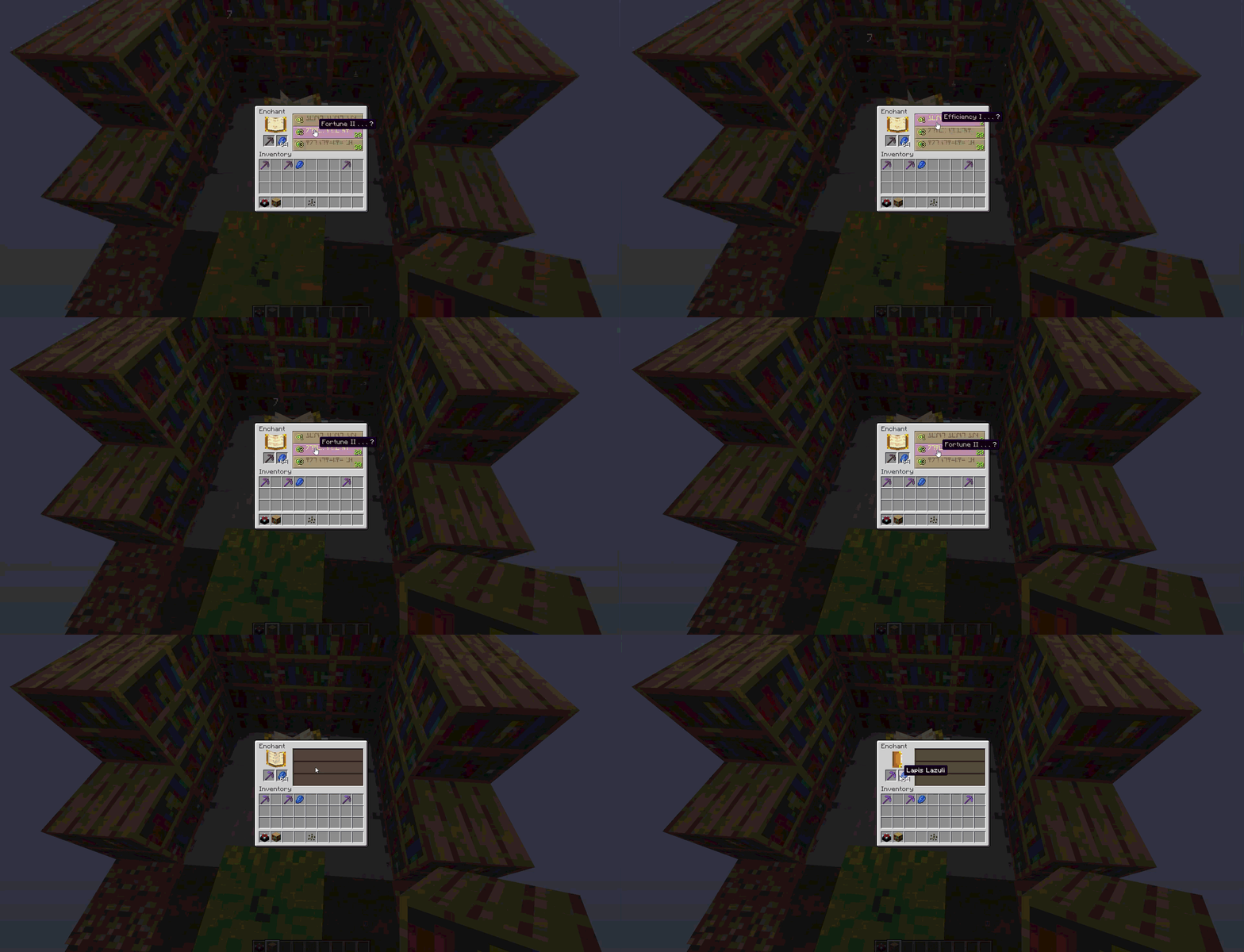
This is the standard way to get enchantments. For Fortune III to appear in the list of available enchantments, several conditions must be met:
Place 15 bookshelves around the table at a distance of one block.
Have the character at experience level 30.
Use 3 pieces of lapis lazuli to activate the third enchantment tier.
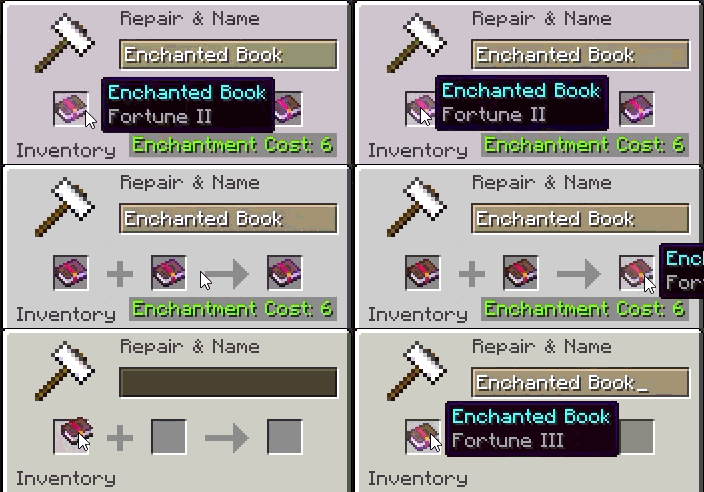
The chance of Fortune appearing is random. If the enchantment does not appear in the list of options, you can "reset" the enchanting grid by applying the cheapest level 1 enchantment to a wooden shovel or book, then check the list again.
Trading with librarians
The most reliable and controlled way to obtain books with Fortune III is by working with librarian villagers.
Find an unemployed villager in a village.
Place a lectern in front of them so they become a librarian.
Check their first trade offer. If there is no Fortune III book, break the lectern and place it again. This will reset the villager's profession and refresh their list of goods.
Repeat this process until the desired book appears. After that, buy any item to lock the trades and prevent accidental profession resets.
Fishing and treasure hunting
Books or pre-enchanted tools with Fortune can be found while exploring the world. They generate in chests of structures like abandoned mineshafts, ancient cities, woodland mansions, and nether fortresses. There is also a small chance to fish up an enchanted book using a fishing rod, especially if it has the Luck of the Sea enchantment applied.
5. Technical details and compatibility with other enchantments
The interaction of Fortune with other game parameters is governed by compatibility rules and internal Minecraft algorithms.
Mutual exclusivity with Silk Touch
The Fortune and Silk Touch enchantments are mutually exclusive. The game prevents simultaneously applying these enchantments to a single tool via the enchanting table or anvil. If an instrument is forced to have both enchantments at the same time using third-party commands or creative modes, Silk Touch takes priority. The tool will mine whole blocks (like diamond ore), and the effect of Fortune will be ignored.
Interaction with other enchantments
Fortune is fully compatible with all other useful tool enchantments:
Efficiency: Increases mining speed without affecting the drop amount. This is a perfect combination for fast ore gathering.
Unbreaking: Reduces the chance of losing durability with every broken block, extending the lifespan of a Fortune tool.
Mending: Allows restoring the tool's durability using experience orbs, which also drop when mining diamonds or coal.
Tool wear: Note that mining a large number of blocks with high item yields does not increase tool wear any more than normal mining. Each broken block consumes exactly 1 point of durability (unless Unbreaking triggers), regardless of whether 1 or 4 diamonds dropped.
6. Comparison with Silk Touch
The choice between Fortune and Silk Touch determines the resource accumulation strategy and logistics during long mining expeditions.
Logistical advantages of Silk Touch
The main problem with using Fortune directly in the mines is rapid inventory overflow.
When mining coal or lapis lazuli ore with a Fortune III pickaxe, one stack of ore blocks turns into 2-4 stacks of ready coal or lapis lazuli. This forces the player to return to base more often to unload.
Using a Silk Touch pickaxe allows for compact transportation of ore blocks (1 block of ore takes up 1 slot). After returning to base, these blocks can be placed on the surface and safely broken with a Fortune III pickaxe.
Economic comparison for different materials
Resource | Advantage of Fortune III | Advantage of Silk Touch | Recommended choice |
|---|---|---|---|
Diamonds / Emeralds | Immediately gives 1 to 4 crystals. | Protects against accidental loss of crystals in lava while mining. | Silk Touch for transportation, Fortune III at the base. |
Redstone dust | Yields 4-8 dust per block. | Preserves blocks for decorative purposes or compact transport. | Silk Touch on expedition, Fortune at the base. |
Netherite | No effect (always drops 1 block). | No effect (the block drops itself). | Any pickaxe to avoid wearing out these enchantments. |
Iron / Gold | Yields 1-4 raw ore (which must be smelted). | Yields an ore block (which can also be smelted). | Fortune III is more profitable as it provides more raw material for smelting. |
Nether Gold | Yields 2-24 nuggets (8.8 on average). | Yields 1 ore block, which smelts into 1 whole ingot (9 nuggets). | Silk Touch is more profitable. |
7. Common mistakes and how to avoid them
Misunderstanding the mechanics of the Fortune enchantment often leads to loss of tool durability or inefficient use of resources.
Mistake 1. Trying to mine blocks that are not affected by Fortune
The Fortune enchantment does not affect blocks that drop as blocks themselves upon breaking and have no alternative drop. For example, mining cobblestone, stone bricks, sandstone, or wood with a Fortune tool will not yield additional blocks. You are just wasting the durability of a valuable tool for nothing.
Mistake 2. Breaking leaves without using a tool
Players often break oak or dark oak leaves with empty hands, hoping to get apples. Although the leaves break instantly, the apple drop rate remains at the base level (0.5%). For Fortune's effect to apply to leaves, they must be broken directly with a tool enchanted with it. A hoe with Fortune III is best for this, as it breaks leaves almost instantly and has high durability.
Mistake 3. Using Fortune on Nether gold ore
Nether gold ore, when mined with a Fortune III pickaxe, yields an average of 8.8 gold nuggets. However, you need 9 nuggets to get one gold ingot. If you mine this ore with a Silk Touch pickaxe and smelt it in a furnace, you will get a whole gold ingot. Using Fortune on this block is a mistake that reduces the amount of gold obtained.
Mistake 4. Expecting an increase in experience (XP)
Fortune exclusively increases the amount of item drops. The number of experience orbs that fly out when breaking coal, diamond, or emerald ore remains unchanged. You shouldn't think that a Fortune pickaxe will help you accumulate character levels faster while working in the mines.
Mistake 5. Ignoring compact storage on expeditions
When you mine deep underground, mining lapis lazuli or redstone directly with a Fortune pickaxe quickly clogs your inventory slots with dust. Always use Silk Touch to gather ore blocks during expeditions, and apply Fortune only after returning to a safe spot at your base.
8. Conclusion
The Fortune enchantment is one of the most important enchantments for speeding up progression in Minecraft Java Edition. By increasing the yield of diamonds, iron, and other key resources by an average of 2.2 times at the maximum level, it significantly saves the player's time on routine searches for ore veins.
However, Fortune is not a universal solution. It shows low efficiency in distant mining expeditions due to the problem of quickly cluttering the inventory with small resources. In addition, for some blocks, like Nether gold ore, using Fortune is economically unprofitable compared to gathering with Silk Touch and subsequent smelting. The best strategy is combining both types of enchantments: collecting ore blocks in the mines with Silk Touch and subsequently breaking them with a Fortune pickaxe at the base.
Leave a comment
Links will be stripped
No comments yet. Be the first to share your thoughts.