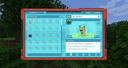
Cobblemon — a Pokémon mod for Minecraft
Cobblemon brings a full Pokémon experience to Minecraft, allowing you to catch, train, and battle Pokémon from all 9 generations.
Cobblemon brings a full Pokémon experience to Minecraft, allowing you to catch, train, and battle Pokémon from all 9 generations.
Cobblemon — a Pokémon mod for Minecraft
Minecraft version this article is based on: 1.21.1
Supported version range: 1.19.2, 1.20.1, 1.21.1
Dependencies: for Fabric — Fabric API; for NeoForge — Kotlin for Forge
Vanilla Minecraft doesn't have creatures you can catch, train, and send into turn-based battles. Cobblemon adds the complete Pokémon game cycle to Minecraft: creatures from all nine generations spawn in the world across various biomes, can be caught in Poké Balls, leveled up in battles, and evolved into their next forms. The combat part runs on the Pokémon Showdown engine, so the mechanics of moves, types, and abilities match how they work in the main series games. The mod is open-source under the MPL-2.0 license and works on Fabric and NeoForge.
Catching Pokémon
Wild Pokémon appear all over the world depending on the biome, time of day, and altitude. Until a battle starts, they behave passively. To check what can spawn at your current location, use the command /checkspawn.
The start of the game involves choosing a starter Pokémon. The M key opens the selection screen: starters from all generations 1–9 are available, and you can only choose once. After selection, the Pokémon goes into your party; the R key sends it out into the world and returns it to its Poké Ball.
To catch a wild Pokémon, it must first be weakened in battle — knocking its health down to the yellow or red zone. Status conditions like sleep or paralysis significantly increase the catch rate. Next, a Poké Ball is thrown using the right mouse button. If the throw fails, the Pokémon breaks out, and the Poké Ball itself disappears — it cannot be recovered. Therefore, throwing blindly without a prior battle is disadvantageous.
Poké Balls and Apricorns
Poké Balls aren't bought — they're crafted. The main material is Apricorns, fruits that grow on trees in various biomes in seven colors: red, yellow, green, blue, pink, white, and black. They are harvested by right-clicking a ripe fruit; if you break the block instead of harvesting, the Apricorn won't grow back. There's a 10% chance when harvesting to also drop a seed, which can be planted like a sapling and accelerated using Bone Meal.
A basic Poké Ball requires four Apricorns of the same color and a Copper Ingot. Different colors yield different types of Poké Balls. Stronger variants require more expensive metals: Great Ball — Iron Ingot, Ultra Ball — Gold Ingot, and the Master Ball, made with Netherite, catches any Pokémon without a chance of failure.
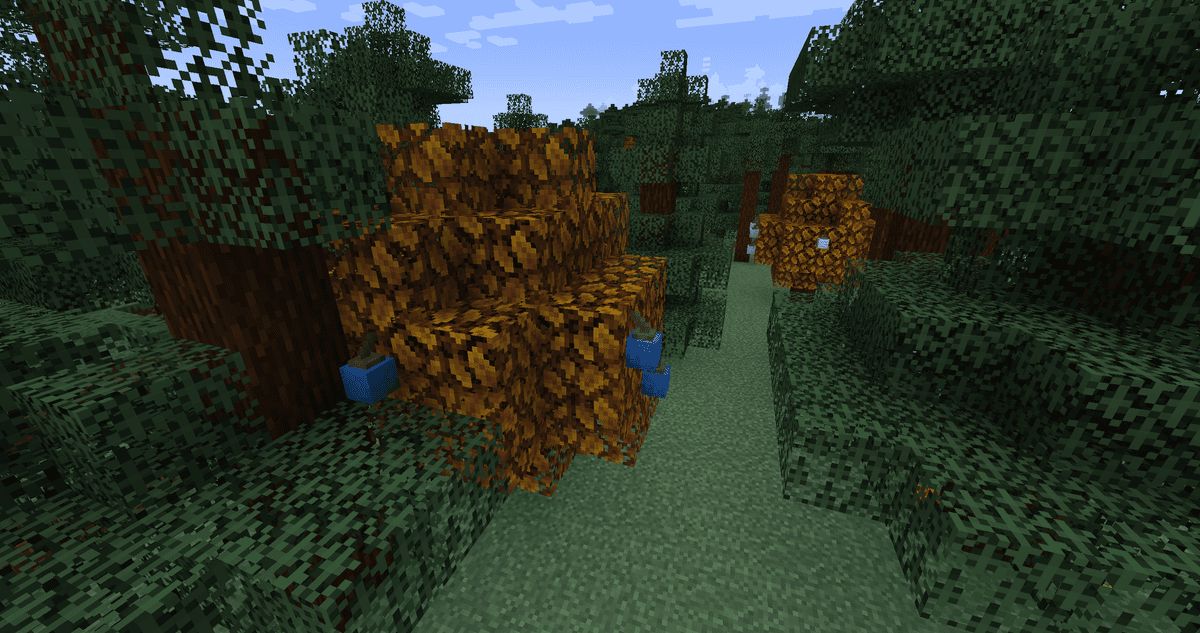
Apricorns growing on trees
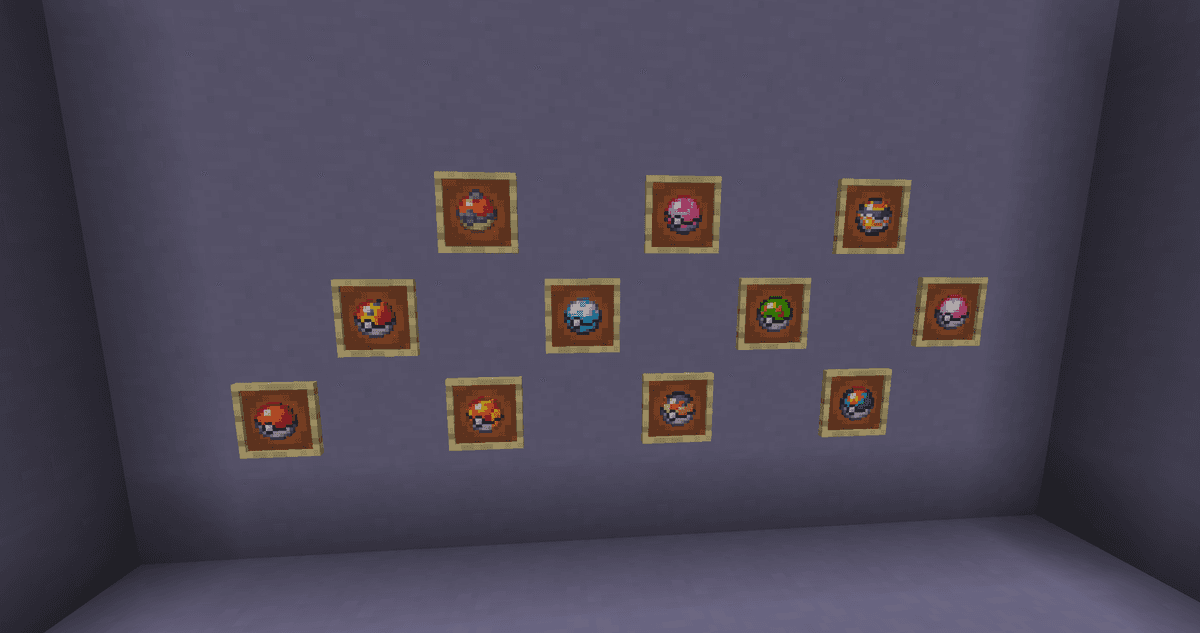
A set of different Poké Ball types, arranged in a row on a solid colored terracotta background
Battles
A battle is initiated by pressing the R key on a wild Pokémon or another player. This opens a turn-based menu with options: fight, switch Pokémon, bag, and run. Turn order is determined by speed, while types, abilities, and held items work exactly as dictated by the Showdown engine.
Two things distinguish combat from the original games. First is free movement: you can enable it directly in the battle interface and meanwhile mine, build, or fight regular mobs. The second is that you can physically run away: simply walking away from a wild Pokémon is enough, rather than having to press a specific button.
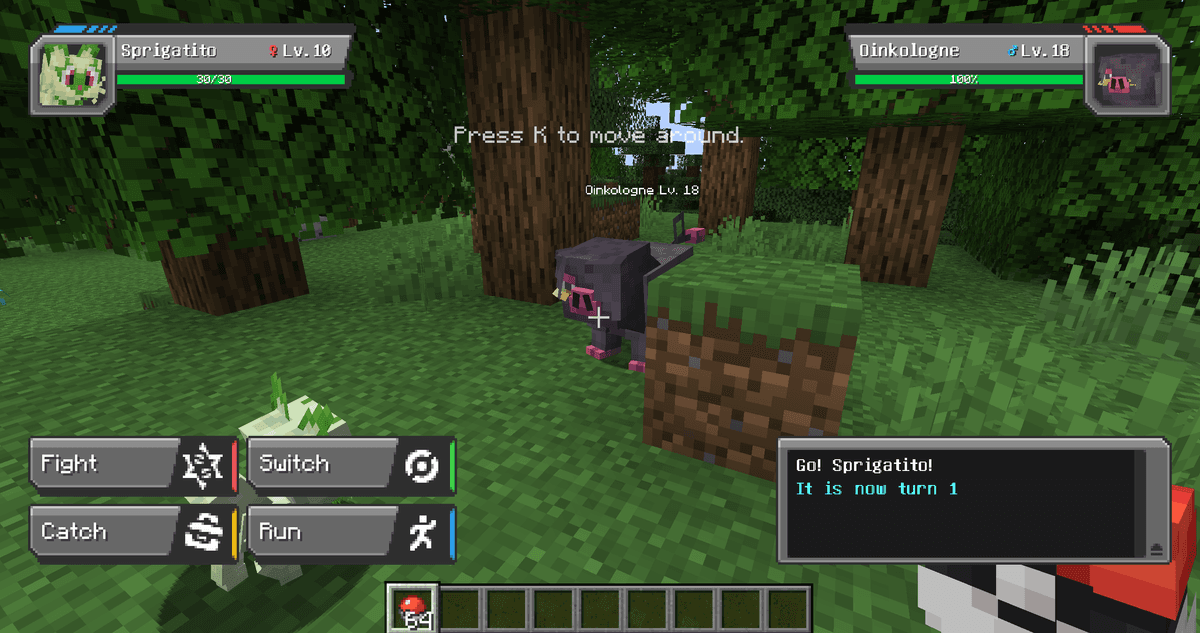
The turn-based battle interface with a wild Pokémon
Leveling up and Evolution
Upon winning, a Pokémon gains experience and levels up to a cap of 100. New moves are learned automatically with levels. Cobblemon takes its system from Legends Arceus: a learned move is not forgotten forever — the set of four active moves can be reassembled at any time through the Pokémon menu.
Evolution is not automatic. When a Pokémon meets the condition, an evolution button appears in the menu (M), and you choose the moment yourself — you can intentionally keep a form unevolved to learn a desired move earlier. Conditions vary:
level — the most common option;
evolution stones — ten types (Fire, Water, Thunder, Leaf, Moon, Sun, Dawn, Dusk, Shiny, Ice) that are mined as ores in their respective biomes;
friendship — gained when a Pokémon fights in your party;
trading — Pokémon that require a trade to evolve do so using a Link Cable, sometimes together with a held item.
Individual Values (IVs) are assigned randomly upon spawning, and Effort Values (EVs) are gained through battles against specific Pokémon — this is the same foundation for fine-tuning stats as in the series.
Pokédex
The Pokédex records who you have seen and caught. Besides keeping track, it has a scanning mode: aiming at a wild Pokémon shows its data even before a battle. This is convenient for spotting rare spawns and Shiny forms. Shinies are rare — the base rate is one instance per 8192 spawns.
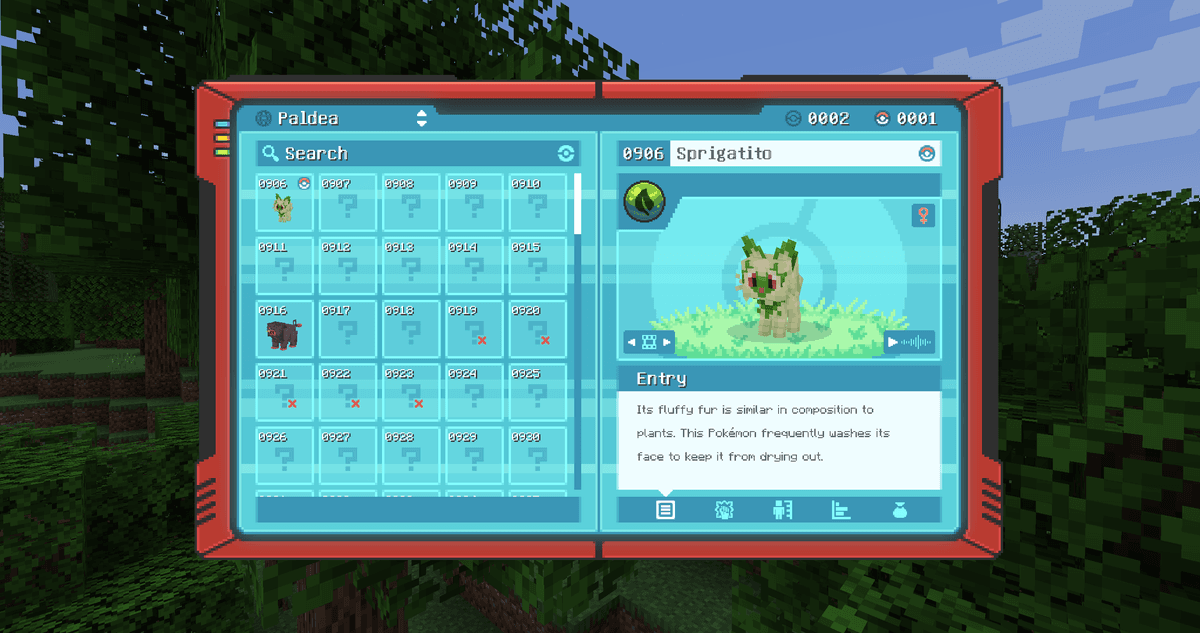
The Pokédex interface with an open Pokémon card
Care, Storage, and Pastures
After battles, the team is healed by a Healing Machine. It's placed at the base, recharges over time, and upon right-clicking, restores the entire party at once. In villages, such a machine might generate on its own — inside a separate Poké Center building.
A party holds six Pokémon. The rest are stored in a PC — a computer block with boxes (40 by default in the config). From there, Pokémon are sorted and swapped with the party.
A separate block is the Pasture. It allows Pokémon to roam freely within an area near the base; through its interface, you set how many creatures graze, and you can allow them to attack hostile mobs.
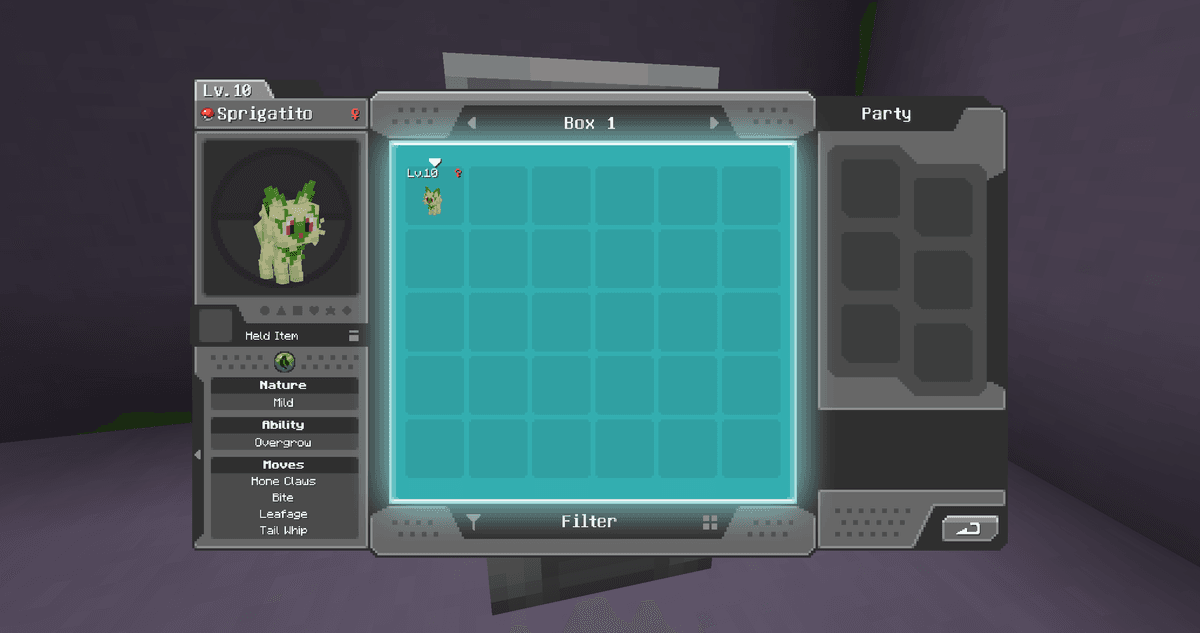
The PC interface with a selected Pokémon
Berries, Medicine, and Fossils
Berries are found in the world, grown on farmland, and mulched for bonuses; different berries can be crossbred to create new types. They are used for medicine: if you put crops and berries into a Brewing Stand, you get potions that heal more effectively than standard ones.
Fossils are obtained by excavating Suspicious Gravel and Sand in specific locations. The collected fragment is revived in a Revival Machine — this is how you get ancient Pokémon that cannot be caught in the wild.
Structures and Riding
Ancient structures generate in the world. Some contain Gilded Chests with valuable loot, and certain ones hide trials with a reward at the end. Along with fossils and stones, this gives a reason to explore the world instead of sitting at the base.
Update 1.7 added riding: suitable Pokémon can be saddled and used for transportation. The method of movement depends on the species — some run on land, while others swim or fly.
Config
Server settings are located in config/cobblemon/main.json. The file is large, so below are the key parameters that affect gameplay the most.
Parameter | What it does |
| enables the natural spawning of wild Pokémon; |
| spawn density per chunk; a higher value means more Pokémon around |
| the upper limit for a Pokémon's level |
| experience multiplier per battle; |
| denominator for the Shiny chance: one instance per this many spawns |
| number of boxes in the PC for storing Pokémon |
| how many Pokémon can be kept in a single Pasture |
| saves wild Pokémon in the world between sessions |
Conclusion
Cobblemon stitches Pokémon collection and training together with survival: Poké Balls are crafted from Apricorns, evolution stones are mined as ores, and medicines are brewed from crops. The main analogue, Pixelmon, offers something similar but relies on Forge and its own assets — Cobblemon, instead, is open-source, runs on Fabric and NeoForge, and is closer in style to the base game. Limitations: the mod is still in development, and Pokémon without a finished model appear as substitute dolls. Suited for those who want a long-term collection goal in survival — completing the Pokédex, building Apricorn farms, and raising a party for competitive battles.
Installation
A typical installation takes about 5 minutes. The flow is the same; only the loader and the matching build differ.
- 1Install a mod loader (Forge, Fabric or NeoForge) that matches your Minecraft version.
- 2Download the mod file (.jar) built for that same version.
- 3Place the .jar into your .minecraft/mods folder.
- 4Launch Minecraft with the modded profile and check the mod loads in-game.
 Installing Mods in Minecraft: A Guide for Forge, FabricLearn how to install mods in Minecraft with this step-by-step guide for Forge and Fabric. Improve your game with new features, tools, and mechanics!Open the install guide