YUNG's Bridges — a mod for natural bridges in Minecraft
YUNG's Bridges was the first mod to add natural bridges across rivers to Minecraft. Before it appeared, no modification introduced such…
YUNG's Bridges was the first mod to add natural bridges across rivers to Minecraft. Before it appeared, no modification introduced such structures into world generation — players either built crossings by hand or crossed by boat. The bridges appear on their own during chunk…
YUNG's Bridges — a mod for natural bridges in Minecraft
Minecraft version: 1.21.4
Loader: Fabric
Mod version: 5.4.0
Dependencies: YUNG's API , Cloth Config API
YUNG's Bridges was the first mod to add natural bridges across rivers to Minecraft. Before it appeared, no modification introduced such structures into world generation — players either built crossings by hand or crossed by boat. The bridges appear on their own during chunk generation, without the player's involvement and without changes to already-revealed parts of the map. The mod does not add new blocks or items — only structures assembled from vanilla materials.
What the mod adds
The mod generates 15 types of bridges, each with several variants depending on the biome. The same type of structure will use a different block palette: in a forest biome — wood of the corresponding species, in a mountain biome — stone or brick. Thanks to this, the bridges look like part of the landscape rather than foreign objects.
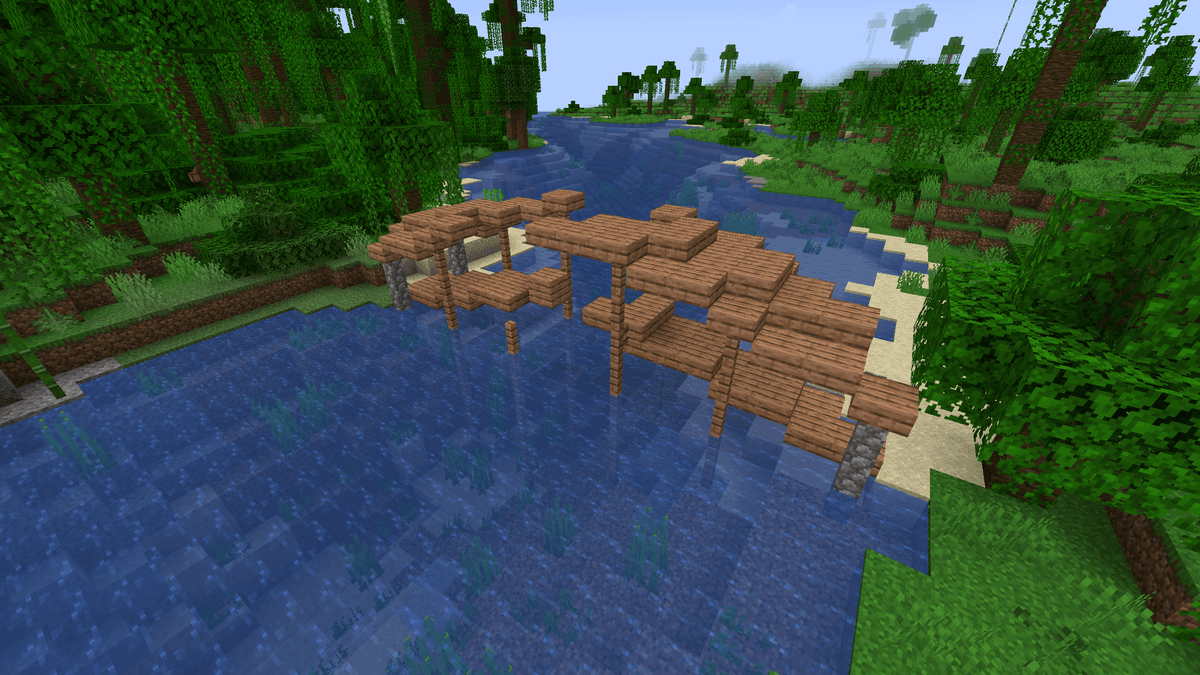
A wooden bridge across a river
The bridges vary in size and complexity. A simple structure of logs or planks spans a narrow channel between two banks. Elaborate stone constructions feature arches, supports, railings, and a span several blocks high. Between them are medium variants: wooden bridges with simple railings or mixed constructions with stone foundations and a wooden deck.
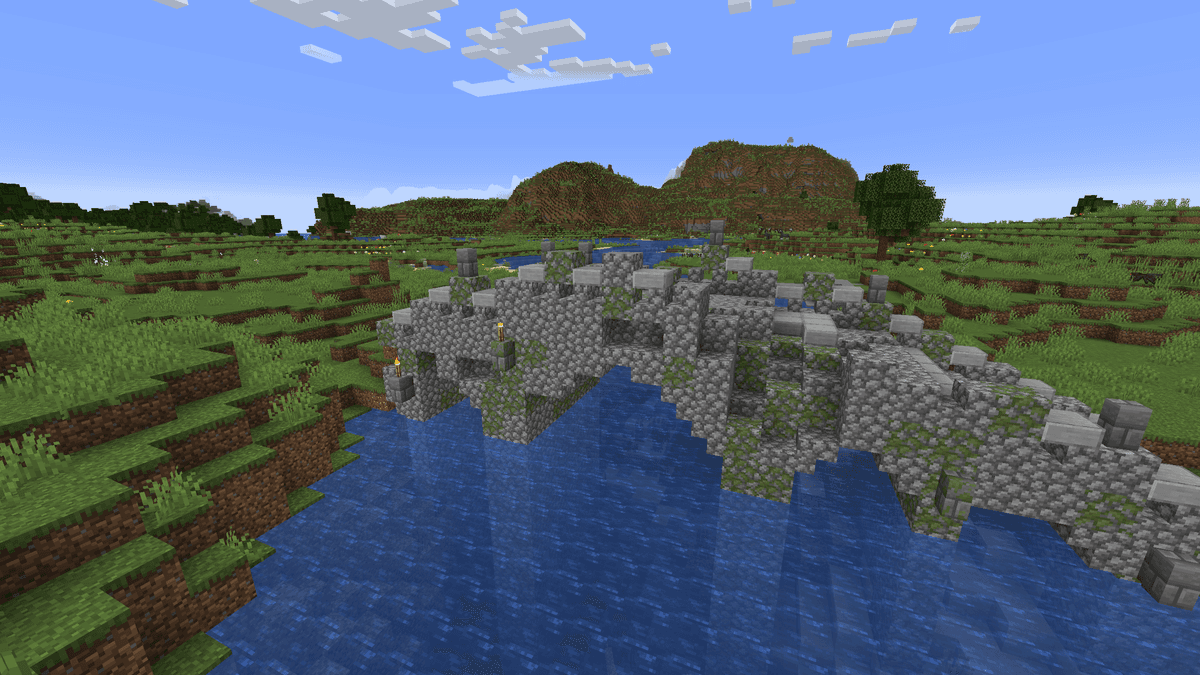
A stone arch bridge
Where the bridges appear
The bridges are generated only in the Overworld — the mod's structures do not appear in the Nether or the End. Underwater areas and the ocean are also not spawn locations: only surface rivers with accessible banks on both sides.
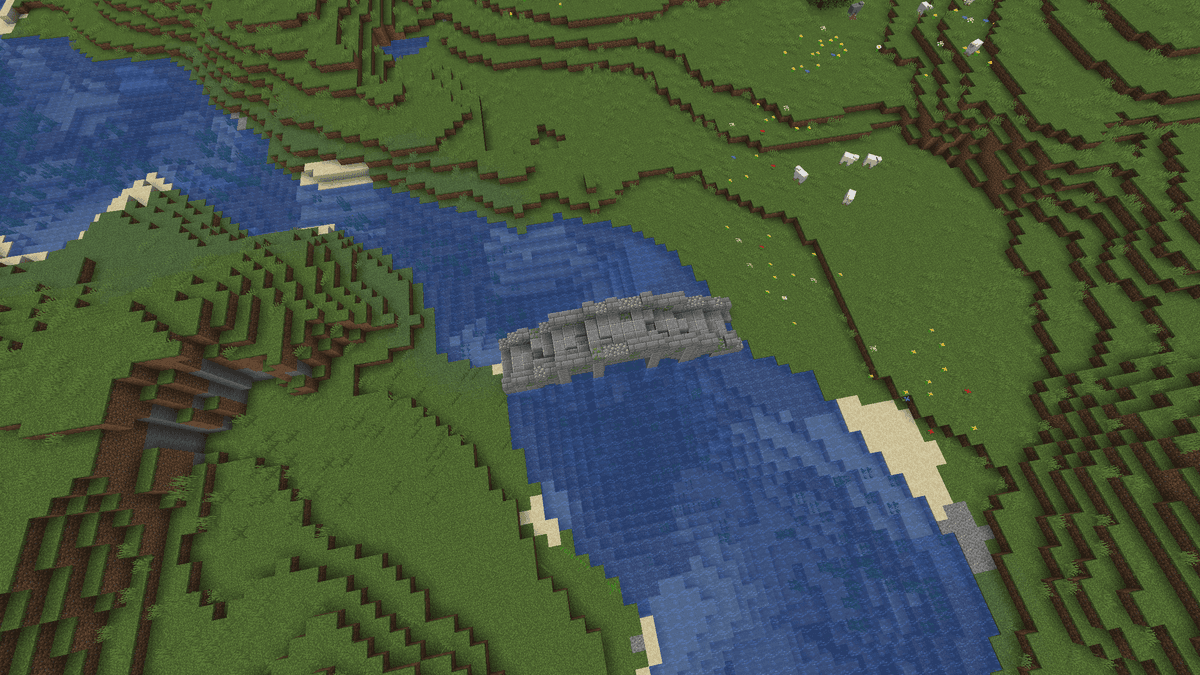
A bridge spawn location — top-down view
The algorithm selects places where both banks are at a comparable height and close enough to be spanned by a structure. Each bridge adapts to the actual terrain: if one bank is a few blocks higher than the other, the structure adjusts rather than hanging in the air. Without suitable terrain, bridges do not spawn in that area.
This is the mod's main limitation: with non-standard river generation, bridges appear less often. Narrow and deep ravines, very wide channels, or steep banks reduce the number of suitable spawn locations.
Types of bridges
By material
A general division by the structure's main material:
Wooden — various wood species. Most common in plains, forest, and swamp biomes.
Stone / brick — ordinary stone, stone with brick, stone slabs. Typical for mountains and stony banks.
Mixed — a wooden deck with stone supports or a foundation. Mostly in transitional and temperate biomes.
By size
By size, bridges are divided into small, medium, and large. A small one is a few blocks wide and 5–15 blocks long, suitable for narrow channels. A large one is an extensive structure with several spans or massive supports that crosses a wide river. Each size group appears with its own frequency, independently of the others.
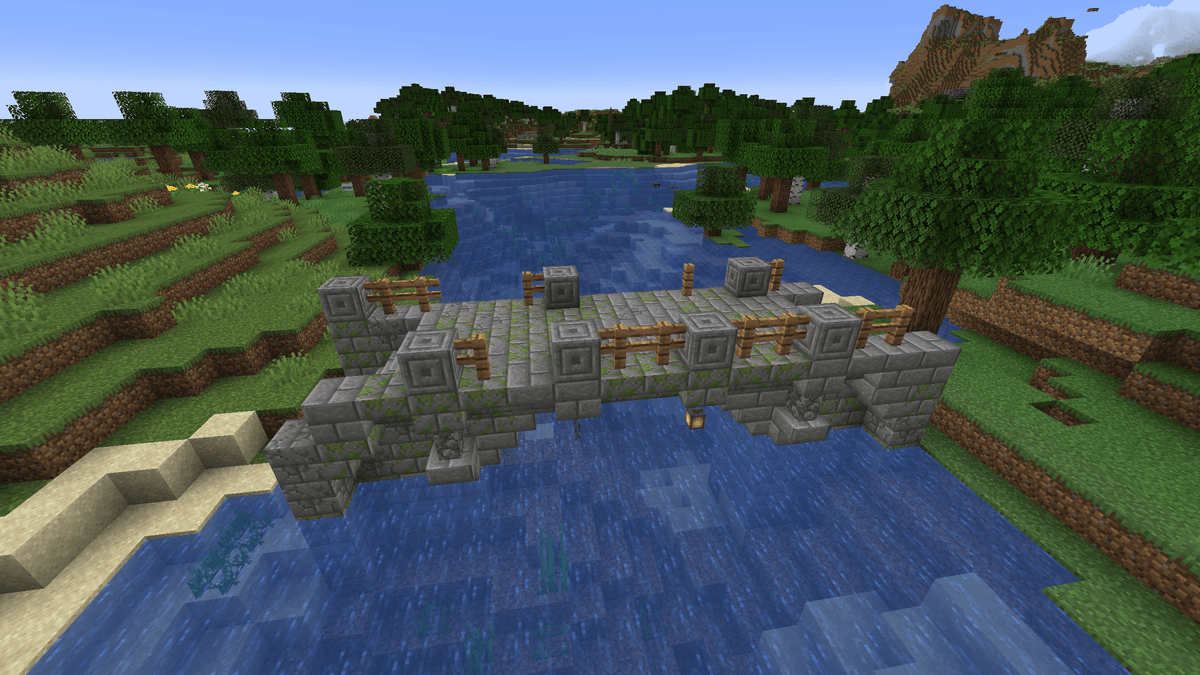
A medium brick bridge
Conclusion
In the vanilla game, rivers are a constant obstacle in open terrain. YUNG's Bridges turns them into landmarks and natural crossings without changing the overall style of the world. The structures do not break the world's general appearance — an adaptive block palette ties them to the biome. The only real limitation is the dependence on the shape of the rivers. On maps with non-standard world generation, bridges appear rarely.
Suitable for survival with open-world exploration, as well as RPG and adventure modpacks where visual richness of the landscape matters. For skyblock or maps without rivers — not relevant.
Installation
A typical installation takes about 5 minutes. The flow is the same; only the loader and the matching build differ.
- 1Install a mod loader (Forge, Fabric or NeoForge) that matches your Minecraft version.
- 2Download the mod file (.jar) built for that same version.
- 3Place the .jar into your .minecraft/mods folder.
- 4Launch Minecraft with the modded profile and check the mod loads in-game.
 Installing Mods in Minecraft: A Guide for Forge, FabricLearn how to install mods in Minecraft with this step-by-step guide for Forge and Fabric. Improve your game with new features, tools, and mechanics!Open the install guide