
How to Build an Automatic Bee and Honey Farm in Minecraft
Step-by-step redstone build for an automatic Minecraft bee farm using comparators and dispensers with shears or bottles, yielding 50+ honey…
How to Build an Automatic Bee and Honey Farm in Minecraft
An automatic bee and honey farm in Minecraft collects honey bottles and honeycombs without player intervention: dispensers with shears or glass bottles harvest full bee nests triggered by a redstone signal, while hoppers send all the drops into a chest. The design is scalable — from a single module of five bee nests to any number of rows. A base module yields approximately 50+ honey bottles or 160+ honeycombs per hour, depending on the number of bees and the dimension where the farm is located.
Version: comparator output from a bee nest and collection via dispenser work in Minecraft Java Edition from the Buzzy Bees update (1.15) and newer versions.
How It Works
Every beehive and bee nest emits a comparator signal equal to the honey level inside. When the level reaches 5, the signal strength rises to 5 — this is enough to activate a dispenser aimed at the hive. The dispenser triggers once, harvests the hive, and resets the honey level back to 0; the signal disappears, and the cycle repeats as soon as the bees fill the hive again. The honey level increases by 1 for every successful return of a bee with pollen (≈2 minutes per flight), so the more bees in the hive, the faster it fills up to 5.
Collecting via a dispenser does not anger the bees. The game doesn't determine who activated a block with redstone, so the bees do not get a target to attack — a campfire under the hive is not needed here. It would only be required for manual collection with shears or a bottle.
Difference in drops: when harvested with shears, three honeycombs pop out of the bee nest as items and fall into the hopper. When collected with a glass bottle, the honey bottle gets inside the dispenser and only pops out when the dispenser is completely full. Therefore, for the honey version, all 9 dispenser slots are filled with glass bottles — otherwise, the drop will remain inside the dispenser instead of falling into the chest.
Preparation
What you will need:
A tool with the Silk Touch enchantment — to move the bee nest along with the bees.
Bees (up to 3 per hive).
A chest and 5 hoppers.
Building blocks and slabs for the enclosure.
5 comparators and redstone dust.
5 dispensers.
Glass or another convenient block for the enclosure.
Flowers.
Shears (for honeycombs) or glass bottles (for honey).
Bees can be obtained in two ways. The first is to find a naturally generated bee nest (they spawn on trees in plains, forests, and flower biomes) and harvest the block using a tool with Silk Touch: the bees will remain inside, up to 3 of them, and will not get angry. The second is to craft a beehive (3 honeycombs + 6 planks) and populate it by breeding bees. Two bees are fed flowers to enter love mode; after a five-minute cooldown, the pair can be fed again. A baby bee will find an empty hive on its own. For maximum efficiency, each hive is populated with up to 3 bees.
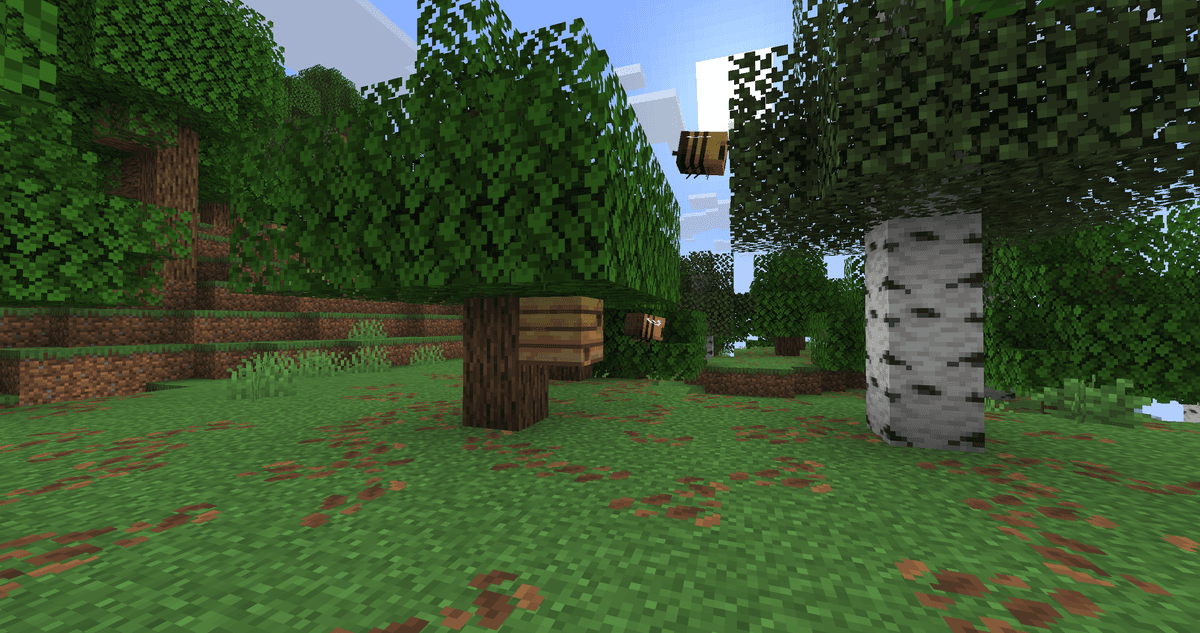
A beehive on a tree with bees residing in it
Step 1. The Collection System
Dig a small niche and place a double chest. Above it, place a row of 5 hoppers so that each one feeds items into the chest. It's more convenient to make access to the chest from the side or bottom — the rest of the structure will cover it from above. This row of hoppers is the single collection point: everything that drops from the hives will end up here.
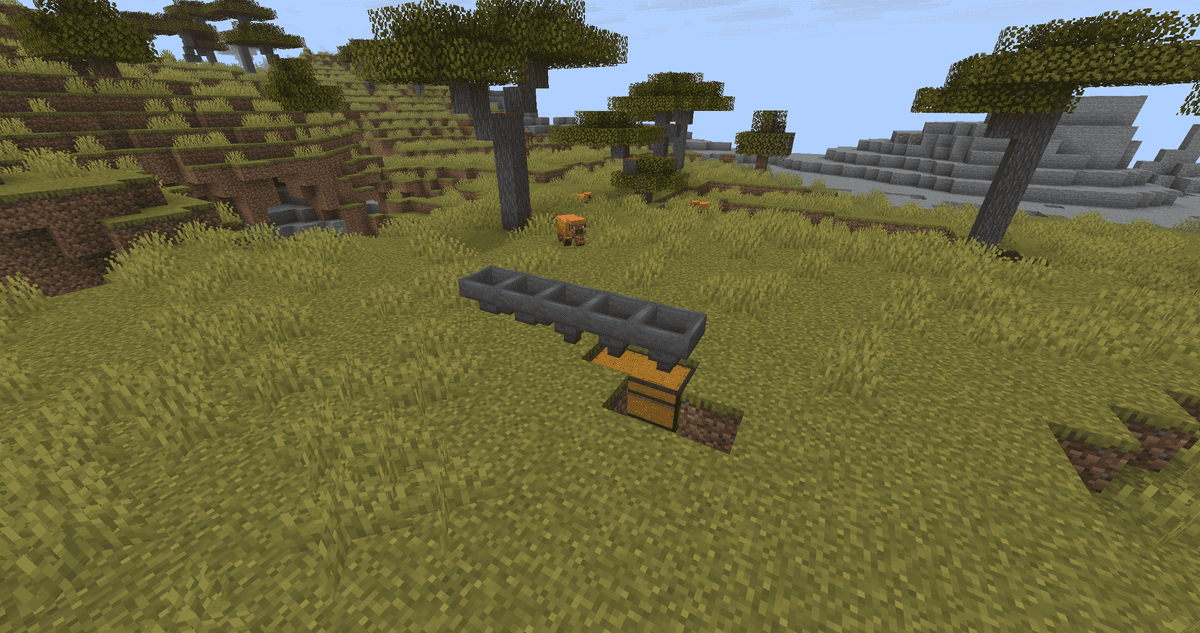
A row of 5 hoppers above a double chest, side view
Step 2. Hives, Comparators, and Redstone
Place a bee nest on top of each hopper — it will sit above the hopper so that drops fall inside. On one side of each bee nest, place a comparator facing outwards: this allows it to read the honey level. Run redstone dust from the comparator outputs to the dispensers.
Keep the redstone line short. A full hive emits a signal strength of only 5, so it won't reach a dispenser across a long path — place the dispenser directly next to the comparator's output or just a few blocks away.
Cover the redstone with blocks and slabs in a way that doesn't break the connection. Orient the hive with its front face towards an open space with flowers — bees exit precisely from the front face.
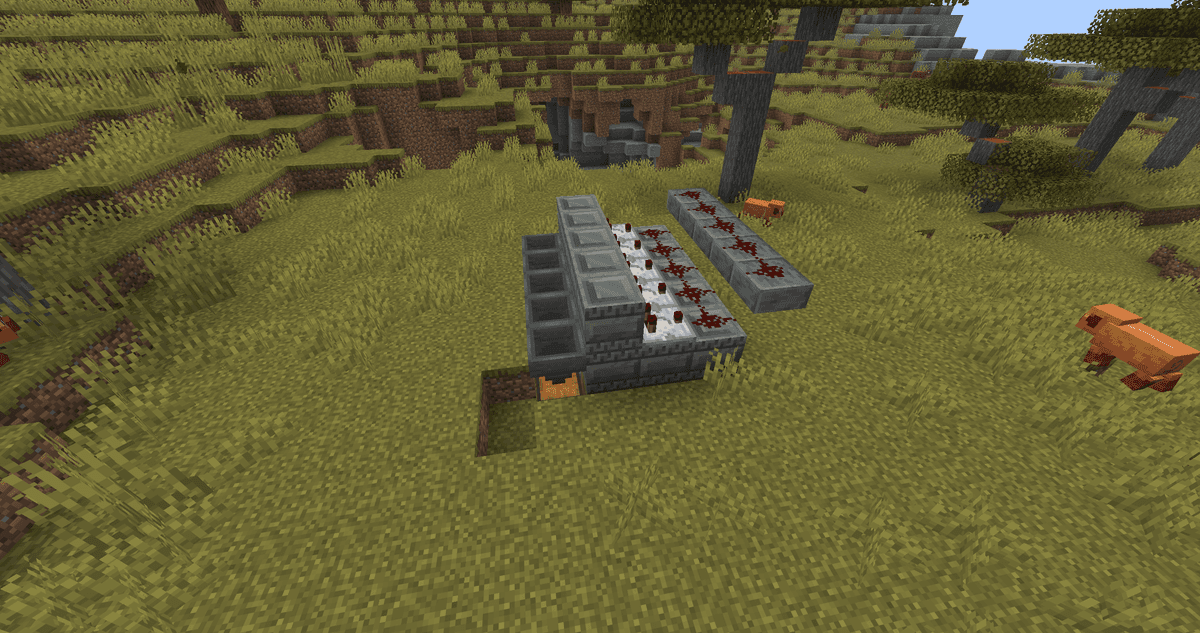
Mechanism with comparators and redstone, cross-section
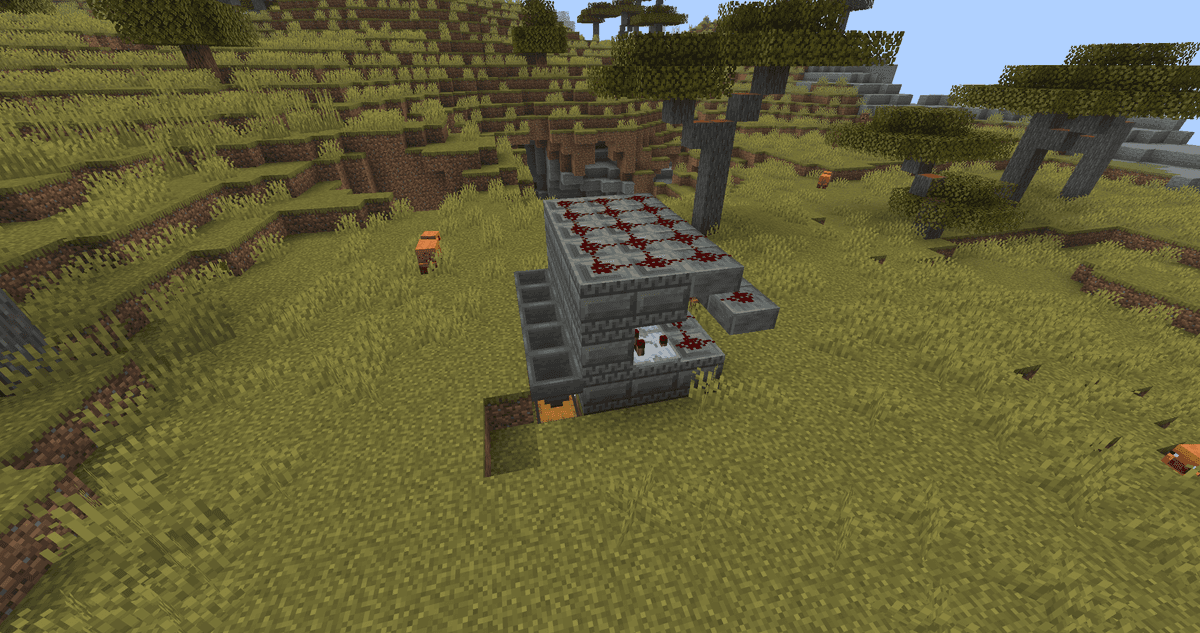
Mechanism with comparators and redstone covered with blocks on top
Step 3. Dispensers and Population
Place a dispenser pointing downwards onto each hive. Fill it with one type of item: shears for honeycombs or glass bottles for honey bottles, one type per dispenser. For the honey version, fill all 9 slots with bottles (see the warning above).
Next to the hives, at the flight level of the bees, plant some flowers — bees pollinate the same flowers repeatedly, so a large flowerbed is not required. Place the hives with bees and enclose the area with glass on all sides, trapping the bees inside with the flowers. As soon as the hive fills up, the dispenser will harvest it automatically, and the drops will flow through the hoppers into the chest.
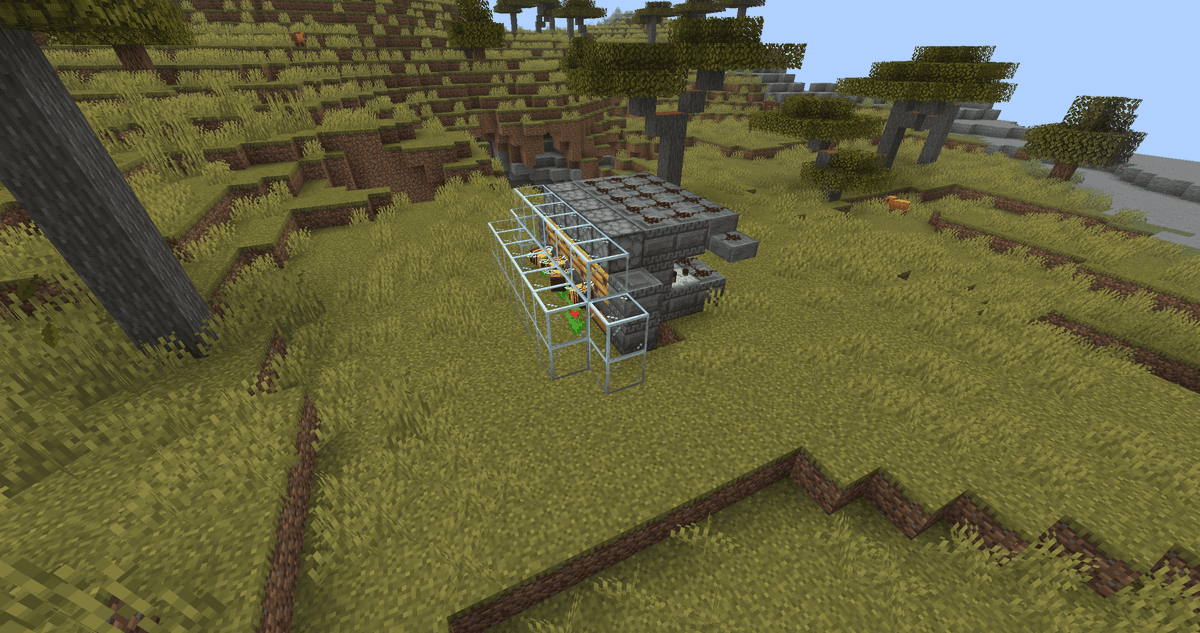
Fully finished bee and honey farm
Expanding the Farm
A module of 5 hives forms one row. To increase efficiency, place identical rows adjacent to each other: each new row of hoppers feeds into its own chest or a shared collection line. The number of rows is limited only by space and the number of bees.
The farm runs faster in the Nether or the End. In these dimensions, there is no rain or day-night cycle, so bees do not retreat to shelter for the night — they fly out immediately once they convert the pollen and pollinate without breaks. Flowers for this are brought from the Overworld.
Bees in the Nether and the End are equally vulnerable to hostile mobs and lava — a solid glass enclosure is mandatory.
Common Mistakes
Honey bottles remain in the dispenser. Not all 9 slots are filled. Solution: fill the dispenser completely with glass bottles.
The dispenser does not activate. The redstone line is too long, the signal of strength 5 does not reach it. Shorten the path or place the dispenser right next to the comparator's output.
Bees got angry during relocation. The nest was harvested without Silk Touch. Harvest only using a tool with this enchantment.
Bees are flying away. The area is not completely sealed — check all sides and the top of the enclosure.
The hive doesn't fill up. There are no flowers nearby or they are out of reach — plant flowers closer, at the bees' flight level.
The farm stops over time. Shears in the dispenser wear out (each activation reduces durability), and glass bottles are consumed with every harvest. Replenish them manually or set up an automatic supply.
Conclusion
An automatic bee and honey farm provides honeycombs for beehives, candles, and waxing copper, as well as honey bottles for sugar and honey blocks. Detecting a full hive is done in two ways: with a comparator, like here (reading the honey level directly), or with an observer (reacting to a block state change) — the comparator is more compact and does not produce false activations. The honey version is more tedious to maintain due to the constant consumption of bottles, while the honeycomb version yields more drops per harvest (3 versus 1). For continuous operation, it is best to keep the farm in the Nether or the End. It's suitable for those who need a steady stream of honey without manual collection — for waxing large copper structures, trading, or stocking up on sugar.
Leave a comment
Links will be stripped
No comments yet. Be the first to share your thoughts.