SEUS — Shaders for Realistic Lighting in Minecraft
SEUS shaders bring directional lighting, dynamic shadows, and realistic reflections to Minecraft, plus software ray tracing in the PTGI…
SEUS shaders bring directional lighting, dynamic shadows, and realistic reflections to Minecraft, plus software ray tracing in the PTGI edition — no RTX required.
SEUS — Shaders for Realistic Lighting in Minecraft
SEUS (Sonic Ether's Unbelievable Shaders) is one of the oldest shader packs for Minecraft. The pack replaces flat vanilla lighting with a system of directional light, dynamic shadows, and reflections. It comes in two branches: SEUS Renewed, built on classic rasterized rendering, and the experimental SEUS PTGI, with software ray tracing.
Visual Features
The lighting is directional: the sun shines at an angle, and each light source has its own tint — the warm glow of a torch differs from the cold light of the moon. Shadows are directional too, with soft edges and depth; even grass casts a shadow.
Shadows: dynamic, with soft edges (soft shadows), react to the sun's position
Water: reflects the sky and surroundings, looking like a continuous surface instead of a set of blocks
Clouds: move, gradually fading toward the horizon instead of static squares
Vegetation: grass, leaves, and fire sway in the wind
Bloom: bright surfaces give off a soft glow under strong light
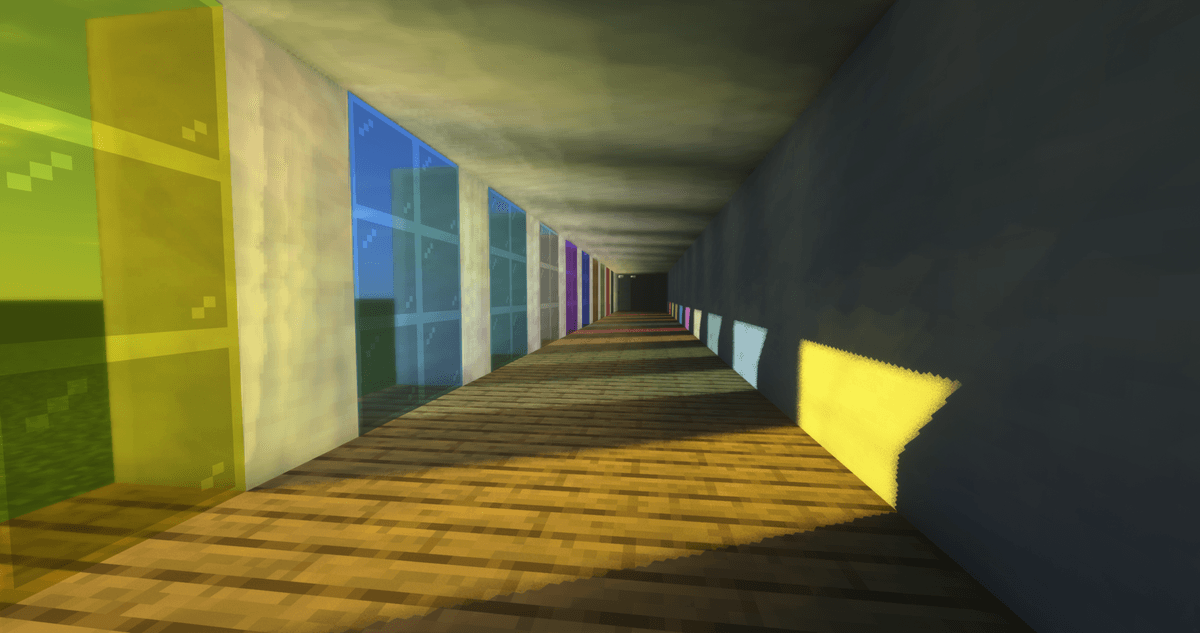
Shadows and lighting conveying the color of multicolored glass
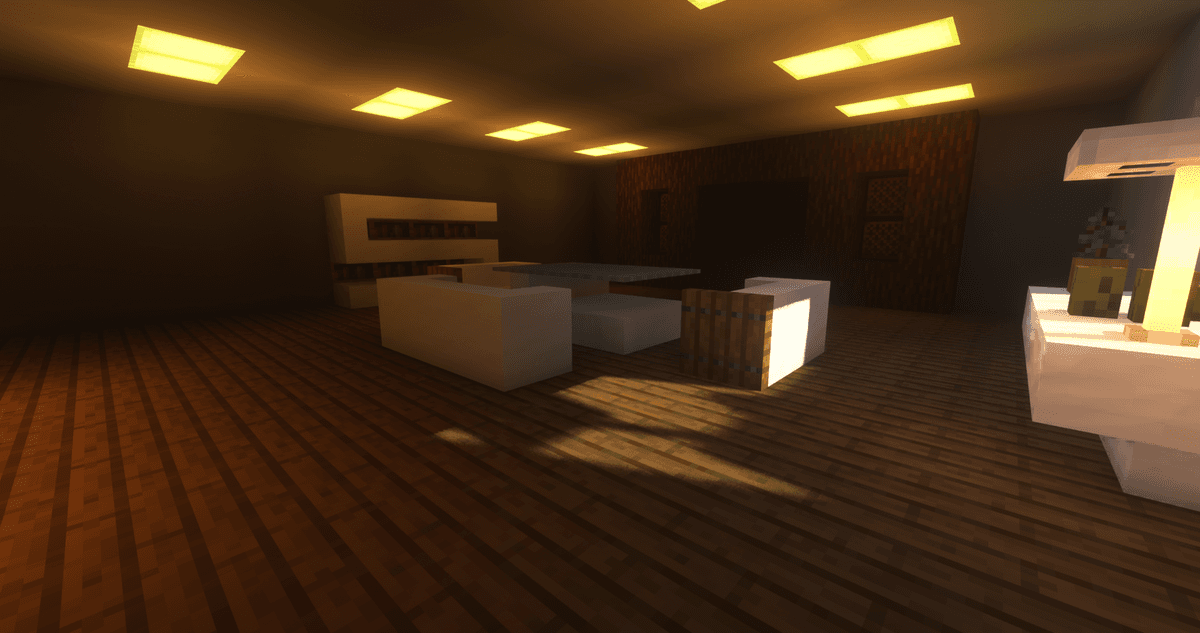
A house interior with soft lighting
SEUS PTGI
PTGI stands for Path Traced Global Illumination — software ray tracing that doesn't require a graphics card with hardware RTX. In this edition, light physically bounces off surfaces and carries color onto neighboring blocks, and traced reflections are added. The calculation is performed by the shader itself on a regular GPU, so the load is higher than in Renewed.
Settings
Options are accessed through the shader menu (Shader Options). To keep FPS up in PTGI, it's worth lowering the render distance and ray tracing quality. If using a resource pack with relief maps, support for normal and specular maps (RP support) and advanced materials is enabled in the same place.
Hardware compatibility: older releases of SEUS PTGI do not run on AMD graphics cards, and support for Intel cards is not guaranteed. PTGI works purely in software and doesn't use hardware RTX acceleration even on cards that support it.
Resource Pack Compatibility
The pack uses the old specular map format — oldPBR (also called seusPBR) — rather than LabPBR. Data about gloss, metal, and emission is packed into the RGB channels of a single specular map. Because of this, PBR textures require a set built for oldPBR/seusPBR (for example, Vanilla Normals Renewed, which supports both standards). A pack made exclusively for LabPBR will render incorrectly in SEUS.
Conclusion
SEUS delivers physically convincing lighting with directional shadows and colored light sources, and in the PTGI edition — software ray tracing without an RTX graphics card, which rasterized packs can't offer. SEUS suits anyone who wants a cinematic look or ray tracing on non-RTX hardware at the cost of some FPS.
Installation
A typical installation takes about 5 minutes. The flow is the same; only the loader and the matching build differ.
- 1Install a shader loader: OptiFine, or Iris + Sodium for better performance.
- 2Download the shader pack (.zip).
- 3Open Options -> Video Settings -> Shaders -> Shaders Folder and drop the .zip in.
- 4Click the shader pack in the list to enable it.
 How to Install Shaders in MinecraftFind out how to install shaders in Minecraft with a simple guide. Improve lighting, shadows, and reflections for better visuals.Open the install guide